
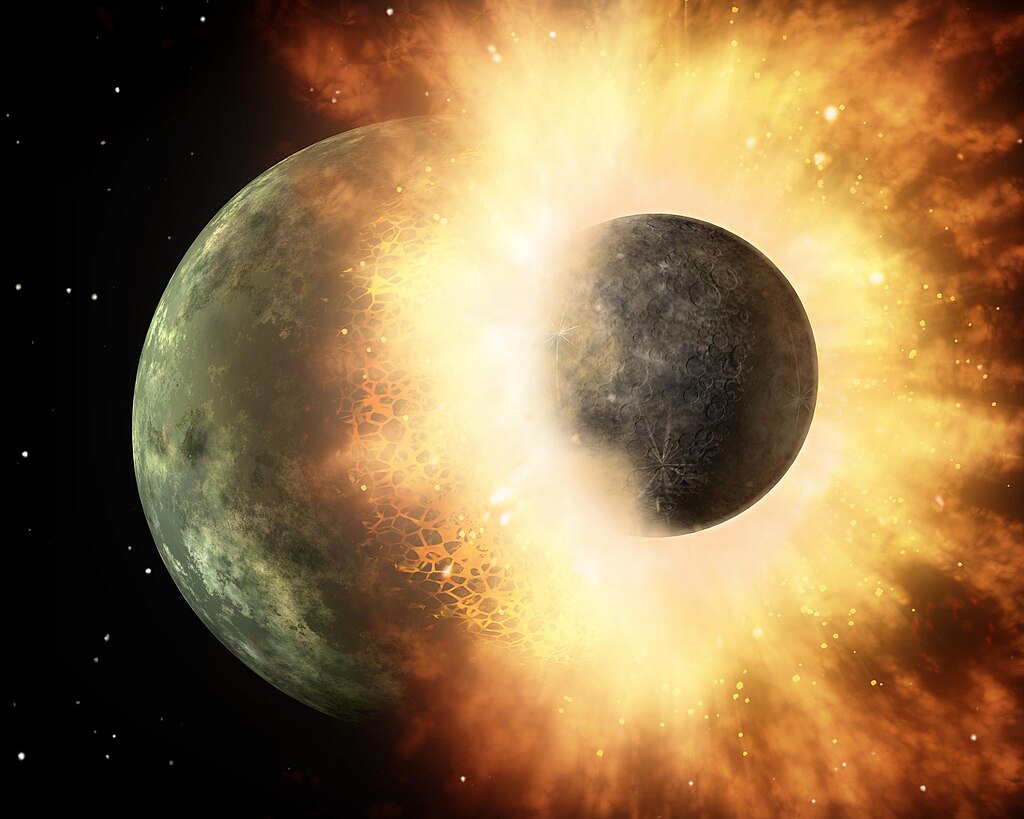
Image in header: Collision between early Earth and Theia. Source: NASA/JPL-Caltech – http://www.nasa.gov/multimedia/imagegallery/image_feature_1454.html
The Moon is something special
Our planet Earth has a remarkably large moon. That is not a given. The other fixed planets do not have it. Venus and Mercury have no moon at all, and Mars has only two small ones. Is that a significant difference? Certainly it is. We will look at how Earth’s habitability is improved by our exceptional moon in the next item (1.15.). But first we ask: how do we get it?
Before, we didn’t actually know how our big moon got there. There were credible hypotheses, but as long as we had to study the Moon from afar, we could not find convincing evidence to hold one of those hypotheses over as most credible. So that changed after the Americans visited the Moon with their Apollo missions. The rocks that the astronauts then brought back to Earth were thoroughly examined. In this investigation, the decisive factor, albeit firmly aided by numerous computer models, has been the outcome. The hypothesis vandaga the absolute favourite: a planet – called Theia – collided with young Earth about 4.5 billion years ago. From the debris of the gigantic collision, the Moon was formed. It is somewhat beyond the scope of this course to go into it in depth. Nevertheless, I like to give a brief summary, because again, we wonder if something similar could happen in a planetary system around a star other than the Sun.
Earth and Moon mantles: quasi no difference in isotope composition
The moon rocks brought to Earth during the Apollo period (1969-1972) give a clear picture: the proportions of isotopes in the rocks on the Moon and Earth are quasi completely the same. And this applies to the various elements studied: oxygen (by far the largest part of the rocks), titanium, silicon, chromium, etc. Consequently, there are only 2 possibilities:
- Either Theia originally formed at the same distance as Earth relative to our star. Therefore, the composition – the elements as well as the isotope ratios – were the same in both bodies.
- Either the bosting with Theia completely destroyed both bodies into a huge cloud of debris and gas, from which both new bodies later emerged after thorough mixing.
These two possibilities are subject to debate in the world of lunar research, but a large majority believe there is more evidence for the first option: Theia was formed close to us, and thus followed Earth’s orbit for some distance. Simulation models of the great collision show that the Moon must have formed largely with matter that originally came from Theia. The Earth, on the other hand, would then have left behind matter that originally came from both Theia and Earth. In that case, you should already see a clear isotope difference.
Couldn’t the collision then have been much more powerful so that both original planets were completely destroyed and formed one big cloud of mixed debris? This theory is less likely, but not definitively disproven. Why less likely? It has to do with the angular momentum (rotational momentum) that the Earth-Moon system has today. Should the system have been created by a frontal full collision between Theia and Earth (necessary to turn the whole thing into one big mixed debris cloud), it is quasi-impossible to end up with a system that has the current angular momentum. Models show that you would then have to have a much larger angular momentum or start from (almost) impossible orbits and velocities of the original planets involved.
Also, a model with smaller or larger versions of Theia (i.e. smaller or larger than Mars-size) are not supported by computer simulations and yield a system with a larger angular momentum than we observe. Moreover, the simulations indicate that a larger Theia would have detached more iron from the young Earth, and so we would find more iron in the Moon.
However, the debate on this issue is not finalised. Some recent studies show that the isotope ratios of some parts of the moon rocks are nevertheless more different from Earth than previously established. In that case, the collision theory could hold, but then Theia might have formed at a greater distance from the sun than our Earth. There iet nothing else to do but travel to the Moon again to allow more investigation of the rocks …
Is such collision between two planets unique?
No, that is not unique at all. When the solar system was just forming, there must have been a gruesome billiard-like scene. Today, we know of eight real planets in our Solar System. But originally, there must have been a dozen large protoplanets, which then very easily collided with each other. Such gigantic collisions had many possible effects: protoplanets crashing into the Sun, being ejected from the Solar System, pulverising each other, or seriously altering each other. The terrestrial planets that have survived until today show quite suspicious features:
- The Earth has an exceptionally large Moon, and is tilted 23° with respect to the ecliptic plane (the plane in which the planetary orbits lie). We can study the Earth-Moon system in enough detail to substantiate the Theia model described above.
- Mercury has a suspiciously large iron core, and a suspiciously thin mantle. Is this perhaps the result of a major collision in which it lost a significant part of its mantle?
- Venus is the only planet that rotates counterclockwise (as seen from the north pole). Moreover, it rotates abnormally slowly. Is this perhaps the result of a major collision in which she was actually flipped 180°?
- Mars is also tilted relative to the ecliptic. Moreover, Mars has a very strange topography. The entire northern half is several km lower than the southern half. Is this perhaps the result of a major collision in which northern mantle material was blown away?
On this, however, we have no evidence. You can come up with all sorts of hypotheses that help explain such observations, but until further notice it remains largely conjecture. It could even be that Mercury, for example, was the planet that once hit Mars. But what is clear: all that protoplanet violence is unlikely to have exactly the properties to end up with an Earth-Moon-like system. That the twins Earth and Theia originated in the habitable zone around our star, that they collided at the right speed and angle, That both bodies were neither too big nor too small, That no other major collisions afterwards disrupted the system, etc. Once again, we were just lucky.