
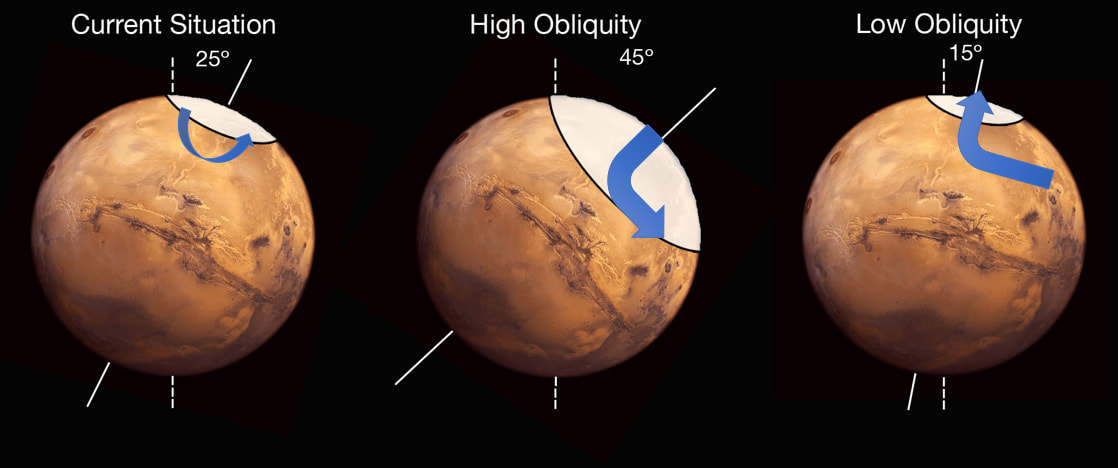
Image in header: Currently, Mars’ axis of rotation makes an angle of 25° with the ecliptic. However, this would have fluctuated a lot in the planet’s history, with serious effects on its climate. Source: https://www.pbecerra.com/the-martian-polar-climate-record.html
The Moon – beautiful but also useful
In the previous entry, we explained that our large Moon is something special. Residents of an exoplanet without a large moon if they suddenly landed on Earth would certainly stare in admiration at that beautiful large disk in our night sky. Also, our Moon is a very rewarding object of study for scientific studies on the history and origin of our Solar System. But why is the Moon important for life on our planet?
Well, the Moon’s positive influence on terrestrial life is partly because of the gravity it exerts, and partly because of the way it was created – the collision with Theia. I explain.
Gravity of the Moon: additional stability
At any moment, the Earth forms a kind of bulge that protrudes very subtly towards the Moon. So that bulge, a bulge of the Earth’s crust, moves across the Earth’s surface along with the Moon. But of course, it is increasingly larger closer to the equatorial region, and smaller towards the poles. Such bulge provides a decelerating force when the Earth’s axis tends to wobble (precession: conical movements of the Earth’s axis like a spinning top also exhibits) or when the tilt of the Earth’s axis tends to increase or decrease (more or less obliquity). Such wobble and oscillation certainly does still occur. But we deduce from geological studies and computer models that the tilt of the Earth’s axis relative to the ecliptic can vary very little compared to, say, Mars, which has no stabilising large moon. On the one hand, the stabilisation is due to the fact that precession is slowed down, which makes the wobbles quieter and less unpredictable. On the other hand, the Moon’s gravity acts on the bulge of the Earth’s crust as a kind of ‘wider spinning top’. Wide spinning tops – with more mass – spin more stably than very narrow spinning tops. Moreover, the Moon’s gravity will somewhat offset the influences of other gravitational disturbances – from Jupiter or other planets.

The more the Earth’s axis is tilted, the greater the difference between warmer and colder seasons. In other words, fewer fluctuations in tilt (obliquity) make for fewer climate extremes. And fewer fluctuations therefore exist thanks to our moon. Is that a big difference, you think? Yes it is. According to numerous computer models, without the Moon, the wobbles and oscillations of the Earth’s axis could vary unpredictably between 0° and 85°! With the Moon, the same models only predict oscillations between 22.1° and 24.5°. So this is vital in the long term! On Mars, by the way, we see that there have effectively been obliquity fluctuations between 0° and 60°.
Gravity of the Moon: tides
High tides and low tides of the sea and adjacent river systems or marshes are caused by the attraction of the Moon and, to a lesser extent, the Sun. And that feature too has provided an advantage to our unique living planet.
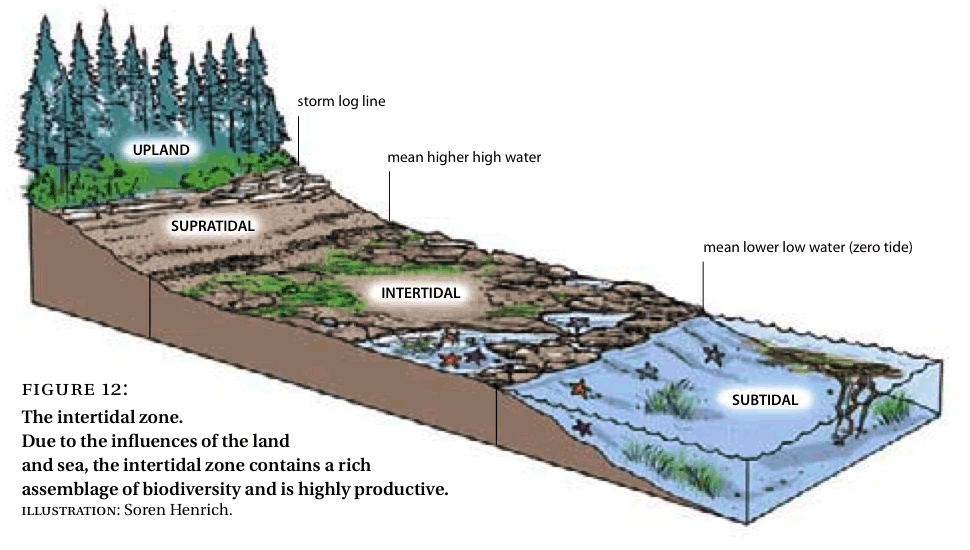
Coastal areas that undergo cycles of tides are usually valuable ecosystems. That is, with high biodiversity. The alternating flooding and drying of pools, marshes, streams and plains challenges life. You can constantly have too much or too little water. This has created high evolutionary pressure, and thus more biodiversity, in these areas. When (especially multicellular) life began to expand from the water to the land, tidal flats undoubtedly played an indispensable role. On the one hand, they suited possible transitional forms that could only live on land for a limited time. On the other hand, it gradually forced certain aquatic organisms to adapt to increasingly land-based life as their habitats increasingly dried up at low tide. Furthermore, tides create dynamic transitions between saltwater and freshwater, mudflats, salt marshes, mangroves, mudflats, fish nursery areas, etc. They help disperse nutrients and oxygen through dynamics, and they also enable certain sea currents near the coast. This allows seawater to disperse and redistribute heat even better (thermohaline circulations), and this is a buffer against climate extremes. Tidal areas sometimes also contain habitats that store additional carbon, and thus can mitigate the greenhouse effect.
In short, the tides caused by the Moon are already making Earth a slightly more habitable planet, now and in the past. This is especially the case for complex multicellular life.

Collision with Theia: contribution to internal heat and iron core
Earlier in this course, we learned that internal heat is vital to our planet. It drives volcanism and plate tectonics, which is still plenty active after 4.5 billion years. Among other things, this keeps the carbon cycle running, which is essential for a long-term habitable climate. Moreover, internal planetary heat is also needed to have a global magnetic field around our planet. This will be explained further on.
Where did internal heat come from again? Well, there are several sources of heat in the interior of our globe. Decay of radioactive elements is a very important one. And for that, you need a planet with enough heavy elements. Very heavy elements are less stable, and so they ‘decay’. Well, in the collision between Theia and young Earth, very many heavy elements from the two colliding planets were left behind in Earth. In other words, Theia increased the concentration of radioactive elements. And not only that. She has also added stable heavier elements. We think primarily of iron. Earth is very iron-rich, helped by the big collision. That gave extra frictional heat when those heavy elements migrated to the centre in the slowly solidifying Earth. After all, they are heavier, so they sink downwards, while the lighter substances float upwards. Moreover, that large amount of iron was important to form the typical core that could create the global magnetic field. And then, of course, there is the extreme violence of the collision itself. When two huge masses collide at great speed, a huge amount of kinetic energy is converted into heat energy. We call this accretion heat. Even today, some of the internal heat is still a remnant of that early accretion heat.
Earth’s high average density is an advantage. It makes for a planet with a lot of internal heat, and thus active plate tectonics, volcanism, and a global magnetic field. It also provides more gravity to hold a thick enough atmosphere. We partly owe this density to Theia.
