
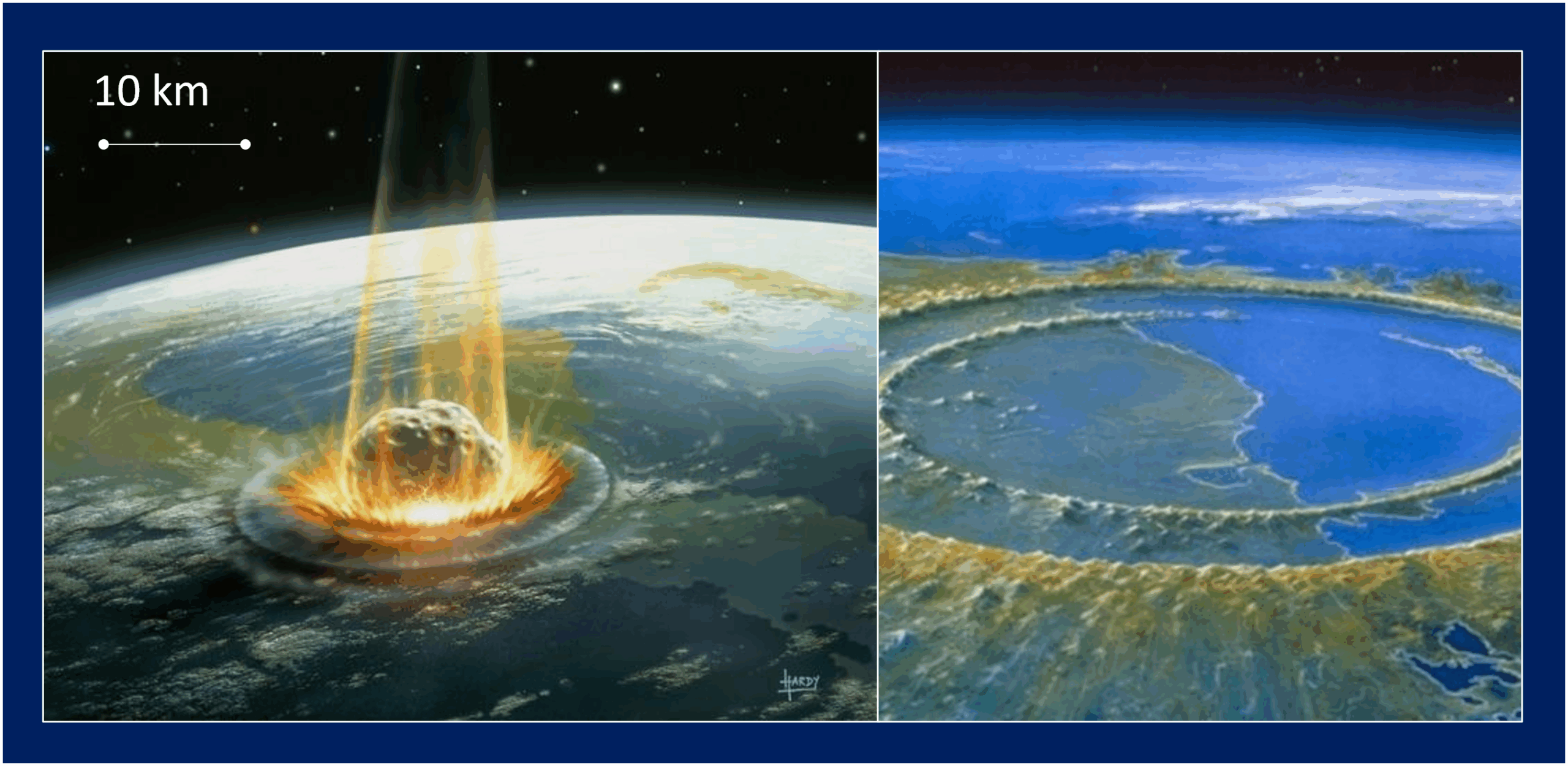
Image in header: Artist impression of the Chicxulub impact (65 MA) and its crater. Source: https://news.qq.com/rain/a/20230609A00Y4600?no-redirect=1
We have talked before about the ‘late heavy bombardment’, the period from 4.2 GA to 3.9 GA during which huge numbers of meteorites fell on Earth and other rocky planets and Moon. There would have been extremely large impacts on average about every 100 years at the peak, possibly vaporising some of the oceans and then raining them back out afterwards. We also know that most of these objects came from the asteroid belt between Jupiter and Mars. But have there been other major impacts since then – in the last 4 billion years – that were equally destructive? Not that we know of.
The most famous major impact is relatively recent, coinciding with the extinction of the dinosaurs. That impact was far too small to (partially) vaporise the oceans or destroy all multicellular life, for example. Nevertheless, this impact had a very big impact on life and the climate of our planet. We try to describe the event briefly below, so that we can still get some idea of the effects of an impacting meteorite of ‘respectable’ size.
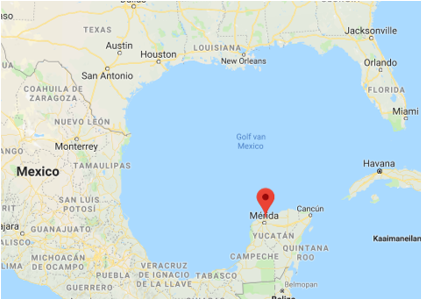
It was 65 million years ago, and the stone must have been about 10 km in diameter. It fell down near a spot where Yucatan (Mexico) and the adjacent Gulf of Mexico now lie. There are also known older impacts that must have been similar in size (Vredesfort crater in South Africa and Sudbury crater in Canada), but their remains are more patchy than Chicxulub. That the Mexican crater formed when animals had long existed, and is also thought to be responsible for a main contribution to the extinction of dinosaurs, among others, makes it much more famous than the others. It has therefore been studied more extensively, and we know a surprising amount about this impact and its consequences.
The impact: immediate effects
The violence that took place at the site of the Chicxulub impact is too great for our imagination. A 10-km-large stone falling to the ground at a speed of 20 km per second (72,000 km/h), can you grasp that? The ground was melted and compressed by the enormous energy, creating whole layers of new metamorphic rocks in seconds. Millions of glowing hot debris – from very small to many metres in size, both original and molten rock – were hurled around up to more than 100 km high. Some fell back down immediately, and some got into orbit around the Earth and will return days or years later somewhere on Earth. The shock wave in the Earth’s crust and mantle causes vibrations that spread all over the planet. Severe earthquakes occur all over the world. Soils crack open, and zones of dormant volcanism become active again. A tidal wave emerges from the Gulf of Mexico and spreads, causing tsunamis on the other side of the ocean that were up to 100 metres high (2-3 times larger than the terrible 2004 Asian tsunami). Meanwhile, glowing debris also came down all over the world, starting a wave of forest fires worldwide. Volcanic gases and hot dust spread everywhere at the same time. Both from the impact zone and from all these secondary impacts came a gigantic cloud of gases rich in sulphates,CO2, nitrogen oxides and methane, among others. The short-term consequence was poisoning and acid rain and acidification of all surface waters.
After that it gets better? not really …
So the days after the impact were a veritable hell on Earth. But there was not much immediate improvement in sight after that. Dr Cem Berk Senel of the VUB makes reconstructions of these impact events, and calculated that after Chicxulub, it must have been completely dark for 622 days on the entire planet, due to the huge amount of dust in the atmosphere. So that’s 622 days of global photosynthesis being shut down. Then some sunlight comes through again, but it would have been darkened for another 10 years or so, still limiting photosynthesis, and leaving 10 years of little solar energy on the surface. So 10 years of winter actually. Most plants and algae die off, and an extreme food shortage ensues.

Slow recovery
When all that deadly misery comes to an end, Earth’s ecosystems can begin to recover based on what survived. But that was little. In the oceans, it is estimated that just over half of all Cretaceous species disappeared forever. On land, it was many times worse. Non-flying dinosaurs disappeared completely. All other plants and animals had lost most of their species. A somewhat ‘experimental’ period of several million years started that produced totally new species. Some more successful than others, and eventually what remained was what shaped modern fauna and flora. For the first hundreds of thousands of years, our planet also went into a fairly extreme greenhouse effect. The huge amount of greenhouse gases spewed out shortly after impact (at the impact site and via secondary volcanism) had disrupted the climate. This is one of the warmer periods the Earth has known. Added to this was the fact that a flood basalt was busy in present-day India for about a million years: a permanently volcanically active ‘province’ of several square kilometres. The graph below makes this story a bit more concrete.
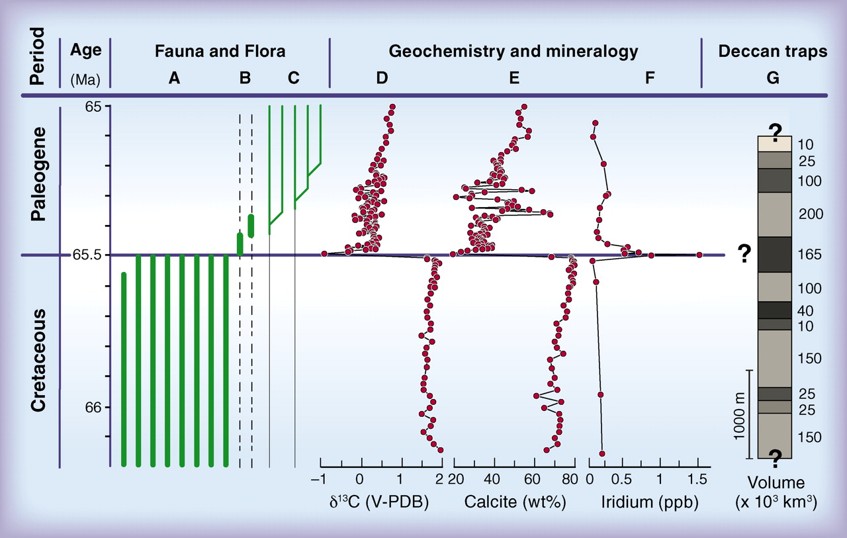
On the figure above, the upper line shows the letters A to G, which are going to guide us through the explanation. The horizontal line on 65MA is the time when the Chicxulub meteorite falls, also called the K/P boundary: the sharp transition between Cretaceous and Paleogene.
A, B and C(Fauna and flora) are symbolic representations of the evolution of biological species. A shows the extinction of 60-75 per cent of all plant and animal species. Their story stops in the first days or years after impact. As ecosystems slowly begin to recover, new niches emerge that need to be filled. Starting from the remaining species, evolution then spawns all kinds of totally new species over the next thousands and even millions of years. The first new species that successfully fill the niches fall under the letter B on the figure above, the so-called opportunists. They disappear again later because the recovery of ecosystems takes place in phases. The later phase, when new ecosystems have developed better, is very different from the earlier phases. The opportunists are then no longer at an advantage, and are competed away by species that are better adapted to the final systems (no longer in recovery, but rather in stable phase). These latter species are shown under “C”. Current mammalian species are an example.
Under D, the ratio of two carbon isotopes is shown, namely C13 to C12. Living cells that extractCO2 from the air or water (photosynthesis, chemosynthesis), they are always going to show a preference for molecules containing carbon-12 isotopes, rather than the variants with carbon-13. So if you find organic molecules in the rock layers with a lower C13/C12 ratio than the standard one, that’s an indication that those organic molecules came from life. And if there is a lot of photosynthesis in the sea, then proportionally more C12 is consumed than C13, leaving the C13 a bit more in the water (and then in the sea floor). Therefore, a rock with a higher C13/C12 ratio than standard indicates a lack of active ecosystem. And the latter is what we see on the graph above from the K-P boundary. Biological productivity suddenly drops to super-low values. And then it takes millions of years to get back to the same level. On the one hand, terrestrial life needed a very long time to develop equally productive ecosystems again in water and on land. On the other hand, the violence of impacts, earthquakes and volcanism had driven a huge amount of historical carbon into the atmosphere. That historical carbon had largely been deposited by older life, and thus had a low C13/C12 ratio, and was everywhere in the sea and atmosphere after the impact.
We also see a similar effect under E, the deposition of calcite. Calcite, or Calcium carbonate (CaCO3) is deposited on the seabed both without and with life. But if there is a lot of marine life, it moves much faster. Because most of this life disappeared due to the impact, you see a very sharp drop in calcite deposition from 65MA. And again, it takes a whole epoch to regain the old values of calcite deposition.
And column F is then the concentration of the metal irridium found in the rock layers. Here we see a very rapid increase just after the Chicxulub impact. Where does this added irridium come from? From the meteorite itself. That space rock contains much more irridium than the Earth’s crust. Because the violence of the impact was so great, the irridium from the original meteorite was ejected into the sky with it, and came down all over the earth. Here we do see that the old values recovered very quickly, because newly deposited rocks were soon no longer touched by the falling debris of the Chicxulub rock.
Finally, we see a column below G, the Deccan Trapps. This is the flood basalt, the active volcanic province in present-day India that has continued to emit lava and gases over several square kilometres for at least a million years. The exact beginning and end of these volcanic deposits are vague, hence the question marks. This column was added to the story because it is not 100 per cent clear to everyone that the Chicxulub impact would have been the sole cause of the great mass extinction. possibly several species of dinosaurs would also have gone extinct without the meteorite. in any case, the fossil record establishes that there were declining populations, and possibly even extinct species, in the last million years before the impact. That the Deccan trapps were already making life more difficult before and after the impact is a certainty.
Chicxulub: decision
A 10-km meteorite severely damaged life on Earth, the carbon cycle, climate, etc. It took a long time for life to recover. On the other hand, it was also followed by a lot of biological renewal, as the former niches were released back. The biological world from the Paleogene onwards is actually drastically different from before.
Will it happen again?
What if an even bigger rock comes at us? Or just as big? And how big is that chance?
With the knowledge we have today, statistics say we should expect an impact of this size every 50 to 100 million years. It is currently 65 million years. Statistics says something about probabilities, not real-world events. We also note that we find nothing about equally large impacts in the last 600 million years (and even older, but then it is much harder to detect). So there seems to be something wrong with statistical estimation.
But coincidence does play a very big role here. to illustrate this properly, I would like to give you something about the pre-history of the Chicxulub meteorite. The story below comes from the book ‘The Story of the Earth’ by Manuel Sintobin (KU Leuven).
By modelling with observational data, scientists have been able to figure out that the Chicxulub meteorite came from the so-called baptistina asteroids. This is a family of asteroids created by a large collision in the asteroid belt between Mars and Jupiter 160 million years ago. The two colliding asteroids were quite large, being 170 km and 60 km in diameter. The result of the collision was a family of thousands of debris-all with the same chemical composition-many of which were in unstable orbits. For more than 100 million years, therefore, Baptistina debris flew around the Solar System, including towards rocky planets. The Chicxulub meteorite is one of those debris and thus landed on Earth 65 million years ago. And the Tycho crater on the Moon is also thought to have been created 108 million years ago by an impact of this asteroid family…. The researchers played a bit with the timing of the collision 165 million years ago, and what did they find out? If this collision had happened 7 minutes (!!!) earlier or later, the Chicxulub rock would not have hit Earth! Would the dinosaurs still have been extinct then? Who knows….

This story illustrates very nicely how small coincidences matter. Unfortunately, we now know that the story is wrong. The model had to be revised after new data was added, including after the study of the Chelyabinsk meteorite that fell down in Russia in 2013. It now appears that the Baptistina collision was 80 million years ago, and thus very unlikely to have provided the Chicxulub stone. Indeed, that would be as early as 15 million years after the collision, which is unlikely short for most larger debris to get out of orbit like that.