
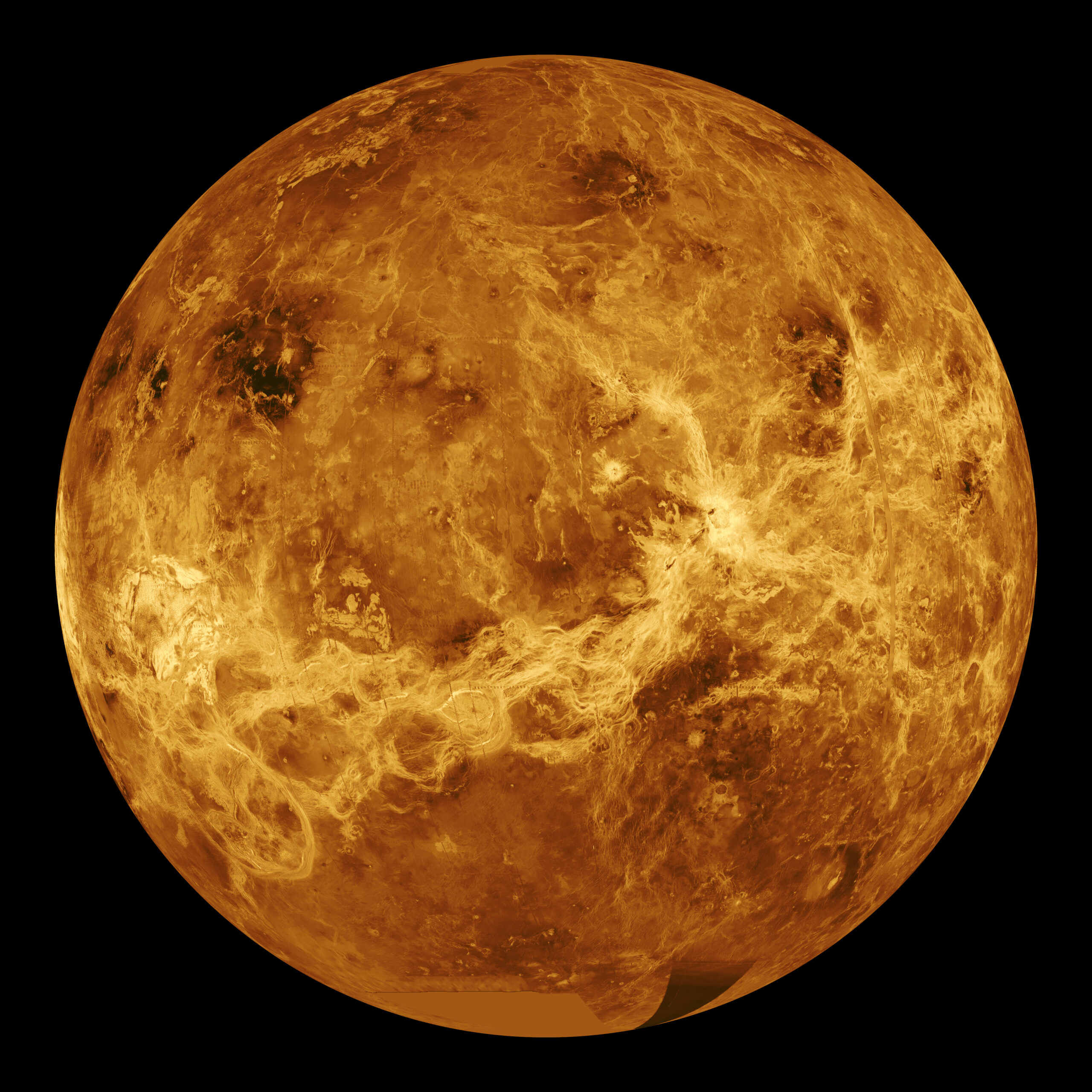
Image in header: This radar image of Venus (without cloud cover, that is) shows the current geologically active surface Source: NASA/JPL
In the section “1.6. Plate tectonics: what and why?” we explained the key features on Earth to make plate tectonics sustainably possible:
- Lithosphere plates that are neither too thick nor too thin, and have ideal stiffness and flexibility
- A plastic layer beneath the lithospheric plates (the asthenosphere) that has neither too much nor too little viscosity at the temperature and pressure prevailing at that location
- Lots of internal heat inside the planet thanks to slow cooling since its formation and high content of heavy and radioactive elements
- Sufficient liquid water on the surface so that subducting lithosphere is hydrated and shows just enough flexibility to keep the slow movement going, and so that the subducting slab keeps volcanism above it active (the water lowers the melting temperature of the rocks around the subducting slab).
Take a good look at the above list. Do you think there is much chance that the other rocky planets in the solar system all match this too? Right. That’s unlikely.
Venus: active but no plate tectonics
(The figures in the text below are from BIRA)
Venus is always called our sister planet. There are good reasons for this. It is almost as big as Earth, its composition is remarkably similar, and Venus’ average density is 95% of that of Earth. Yet very large differences exist and Venus is a very unlivable place by our standards. The average surface temperature is 464°C, it rains sulphuric acid, atmospheric pressure is almost 100 times greater than ours, and there is virtually no water on the surface. The atmosphere contains 96.5% CO2 and the remaining 3.5% is N2 (nitrogen gas). The atmospheric concentration of water is only 20 ppm. At one time there must have been a lot of water like on Earth, but the planet is too close to the sun, and in the first billion or 2 billion years could not prevent an extreme greenhouse effect. Such an out-of-control greenhouse effect (English: Runaway greenhouse) turned this planet into a dry hell.
The cloud cover on Venus is so dense that you never get to see the surface when viewing the planet from outside. At least in ordinary visible light. Mainly thanks to radar images from space probes that have gone to Venus, we still have a good picture of the surface, and it turns out to have a lot of geological activity after all. For instance, there are clearly higher massifs that we call tesserae. They are reminiscent of terrestrial continents. Some scientists see an analogy with cratons, ancient stable continent massifs on Earth. But all indications are that the tesserae are uplifted crust without the intervention of submerging plates. The tesserae are full of intricate deformations though, with ridges and valleys. But we do not find clear plate edges anywhere. Nor do the deformations follow main directions as you see in terrestrial lithosphere plates. If there are any structures resembling a plate edge, we rather see fusion of both sides, and no sign of plates moving above each other.
Besides the Tesserae, we also see crustal movements of other types:
- Rift formation: pushing open crust, but without plate edges all around.
- Coronae: round pushed-up areas ogeven by fractures and ridges.
- Local mountain ranges due to locally pushed up crust
- Large volcanic zones
- Pancake domes: pushed-up crust over which lava fields have formed.
All this geological activity shows that there is a lot of mantle activity and thus a lot of internal heat in the planet. But the crust forms one big planetary thick plate. The high temperatures make the lithosphere slightly more plastic than on Earth (not enough rigidity), and the absence of water then makes tectonics even more unlikely. We also see that the number of craters are rather evenly distributed across the entire surface, suggesting that the entire crust is about the same age everywhere. It is true that the crust is estimated to be younger than the planet itself. But that is not explained by plate tectonics. Presumably at some point (500 million years ago?) there was a sudden renewal of the crust all over the planet with fresh mantle material. Much more research will be needed to really find out exactly what processes those were and why they occurred.
Mars: active history
Mars has very strange topography, to say the least. The whole of the northern hemisphere is several kilometres lower than the average in the south, as well as being much flatter. And then you have that giant Tharsis plateau where giant volcanoes are located and the largest rift in the Solar System Vallis Marineris. Exactly how this strange surface was formed is not yet entirely clear. Much of the topography is the result of massive meteorite impacts. But another main lead is large-scale geological and volcanic activity. There is no indication of lithospheric plates or any plate boundaries. Mars has a thick planetary crust consisting of one continuous shell. But there have clearly been vertical movements of that planetary crust, of which the Tharsis Plateau is by far the greatest. Volcanism during the lifting of that plateau emitted so muchCO2 and water, according to Roger J. Phillips, that the whole planet could be covered with 120 metres of (extra) water, with aCO2 pressure of 1.5 bar above it (i.e. 1.5 times Earth’s current atmospheric pressure). The entire plateau would have previously been at 50° north latitude. However, such bulging bulge is heavy, and has slowly moved towards the equator by centrifugal force.
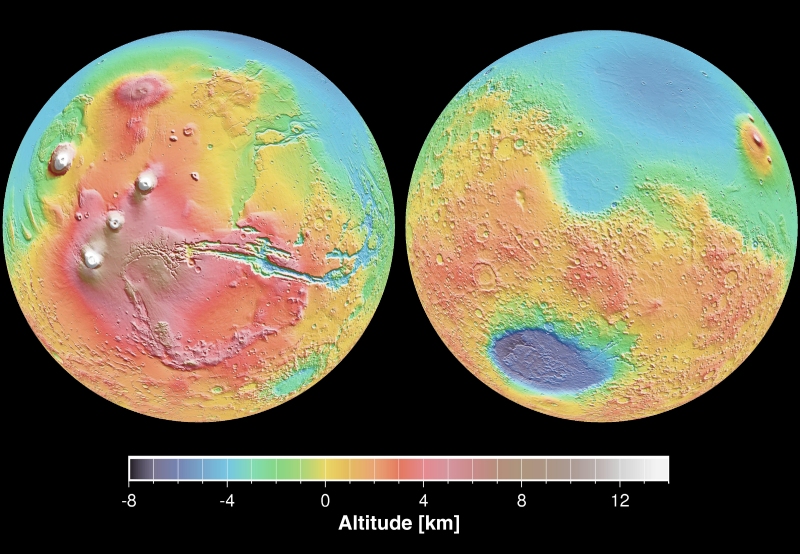
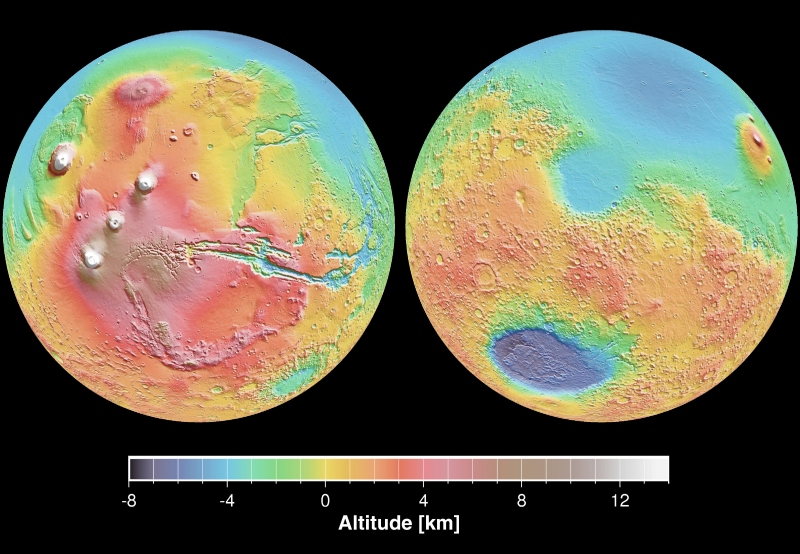
So there has certainly been a lot of geological activity on the red planet. Such topography and volcanoes show that the mantle must have had quite a lot of internal movement in the past: convection due to heat differences. However, because the planet is much smaller than Earth (about half the size in diameter, about 15% of Earth in volume), it could cool down much faster. Because the ratio surface area to volume is then greater, and so you have more contact with cold space per unit volume. Moreover, Mars largely lost its atmosphere, which only caused more cooling. Activity in the mantle and crust is barely detectable today, but not completely gone, as shown by the recent survey with NASA’s Insight lander. Mechanisms such as plate tectonics are completely absent. We will come back to this in more detail in the course section on Mars.
Mercury and Moon: geologically ‘dead’ and cold
The Moon and Mercury are still a lot smaller than Mars, so also cooled down even faster after their formation. Both form more or less a ‘cold rock’ today, where there is no volcanism at all. Here, too, we see no trace of plate tectonics, not even in early history. For both Mercury and the Moon, topographic variations are almost entirely due directly or indirectly to impacted meteorites. Yet there are exceptions to this too. As cooling continued over the billions of years, shrinkage effects have occasionally occurred. Moreover, this can cause quakes to take place in the subsurface. The shrinking is similar to a grape or an apple drying out completely, and getting wrinkles. However, the crust of the Moon (and also Mercury) is not so flexible, so instead of wrinkles, we find fractures and cracking.
