
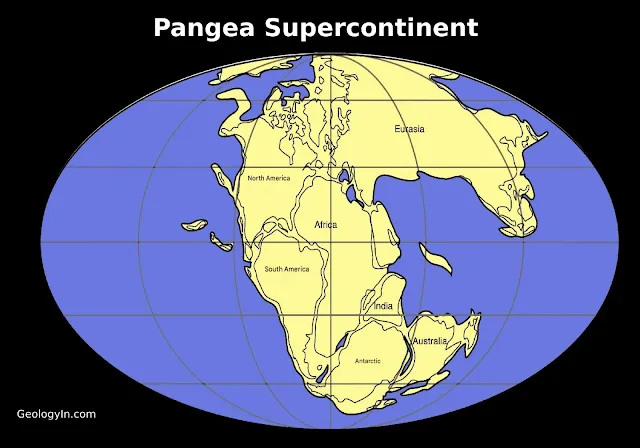
Image in header: The most recent supercontinent Pangaea during the Mesozoic. Source: https://www.geologyin.com/2024/11/earth-supercontinents-rodinia-gondwana-pangea.html
Hopefully, after the previous chapters, you are convinced that plate tectonics is indispensable for our planet’s habitability and great biodiversity. For four billion years, unlivable extremes have been avoided, and since the emergence of life, biological evolution has produced non-stop new forms and strategies. The creativity and diversity of terrestrial life is so great that we can never fully grasp it with our human brain.
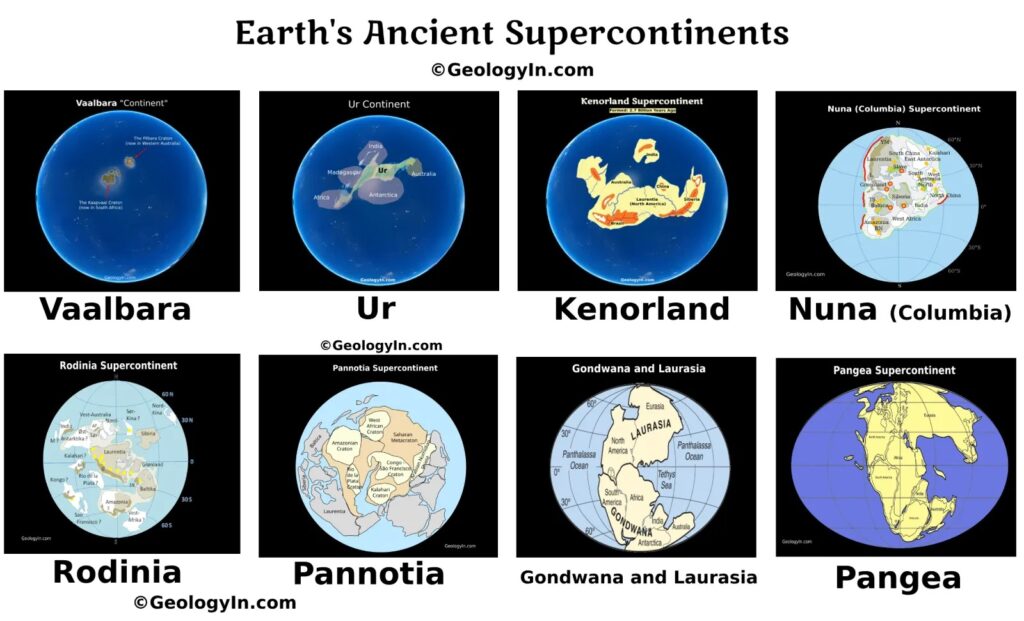
A driver of biological evolution is changing environment. In this, plate tectonics plays one of the main roles. Over the long term – hundreds of millions of years – supercontinents are formed on Earth and then fall apart again. In stable core parts of some continents (Cratons), we find remnants of about 8 supercontinents in the last 3 billion years. You can reconstruct them if you detail and date palaeomagnetic data and old geological patterns of the cratons from several current continents and thus put pieces of the puzzle back together again per period. The number of historical supercontinents does depend on the definition you use. The usual definitions speak of a supercontinent when 50% to 75% of all land mass on Earth lies in one continuous continent.
In any case, such supercontinents have always had a very big impact on the conditions that prevailed on Earth because of the following effects:
The oldest supercontinents first triggered a number of systems so characteristic of our Earth: shallow seas that enabled massive photosynthesis (then only by bacteria), thus adding oxygen first in the ocean and later in the atmosphere. One of the most remarkable periods was 2.4 billion years ago (2.4 GA): Great Oxygenation Event (GOE). This one is also called the greatest poisoning ever on Earth. We will also come across this later in this course. At that time, the supercontinent Kenorland existed. The impact of the GOE was revolutionary for life at the time (see part 2), but also for the climate. This was one of the biggest climate disruptions in history, a very large cooling that left almost the entire Earth covered in ice. This was the oldest known ‘snowball Earth’ period. The impact on crustal formation and mantle dynamics was also very large. Plate tectonics then began to take its present form.
The first supercontinents were much smaller than today’s land masses. Each new supercontinent was larger than the previous one in the first half of Earth’s history. As more land mass and mountain formation was added each time, the effect of silicate weathering became more important. Our famous ‘thermostat’ got a sufficient grip on the climate just in time, as the sun continued to brighten relentlessly (but very slowly). Ever larger supercontinents allowed the concentration of greenhouse gases to decrease slightly over the very long term, while solar energy continued to increase slightly.
Once life became numerous on land, the formation and breakdown of supercontinent Pangaea played a major role in species formation. For instance, many species were able to spread uninhibitedly over large parts of Pangaea. When this supercontinent fell apart again (from the Jurassic period onwards), populations of it became isolated from each other, and completely new species arose on the separate smaller continents. This had a particular effect on dinosaur species formation.
Some other effects of formation and breakdown of supercontinents are:
| Supercontinent formed | UIvents and spread |
| There is more room for old oceanic crust, and it sinks deeper: sea level drops. There is less shallow water, and thus less habitat with typically high biodiversity and biomass. More continental climate, more ice formation on land. Quieter crust, less volcanic activity, so less greenhouse gas emissions. | Higher sea level (less ancient oceanic crust). More contintental crust underwater, so more shallow water with high biodiversity and high bio-production. Less ice formation on land, more temperate marine climate. More volcanic activity due to more active crust, more greenhouse gas emissionsCO2 and CH4. New openings between continents allow sea currents that redistribute heat globally: less local climate extremes. |