
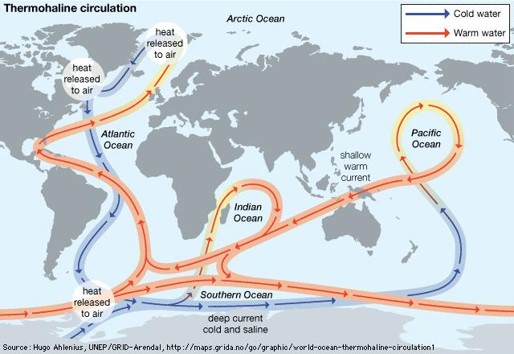
Image in header: Earth’s main ocean currents that transport and distribute heat across the planet. Source: https://www.britannica.com/science/thermohaline-circulation
Water is a buffer and transport medium for heat
The image above shows the global transport of heat in the oceans via the thermohaline circulation. It permanently redistributes heat our planet. In English, this system is also described as the ‘conveyor belt’. The whole of this system has a very strong influence on all climates worldwide. In Europe, for example, our climate is much warmer than in locations elsewhere in the world that are equally far north (at the same latitude). This is because the Gulf Stream brings warmer water from the subtropics. Does this matter that much to us? Yes it does. If the Gulf Stream shuts down, we have to make do with an average of 5 to 10 degrees less here! This is no mere fabrication. About 12 thousand years ago, this effectively happened for a relatively short time. We call this phenomenon the ‘Young Dryas’. Read the interlude on this to understand what happened then.
Antarctic ice also depends on thermohaline circulation. Around the South Pole, a marine current runs completely in a circle, a bit like a moat. This is called the Antarctic circumpolar current. Warmer seawater from the north cannot therefore come near the South Pole. So without the circumpolar current, the ice sheet would be smaller.
Of course, the global thermohaline circulation has not always been the same. When continents had different positions, the pattern looked different. One of the most famous examples is the closing of the Isthmus of Panama (about 3 million years ago, some think longer ago). This added new landmass between North and South America, eventually closing the strait between the two. It is then that our beloved Gulf Stream came into being and the whole sea current pattern we have today, including the Antarctic circumpolar current. Europe got warmer because of the Gulf Stream, but the Arctic got more snowfall, and thus a larger ice sheet. Earth’s global temperature has dropped since then.
In short, terrestrial climate is largely dependent on ocean currents. Without redistribution of heat through the oceans, we would have more extreme climates, and our planet would be less livable. So for this to be possible, the planet must be largely covered in liquid water. On the moon Titan, there are also pools, but there the liquid is mainly methane, not water. Less interesting, because water has some characteristics suitable for enabling the pattern of marine currents: high heat capacity and variations in weight due to variations in temperature and salt concentration.
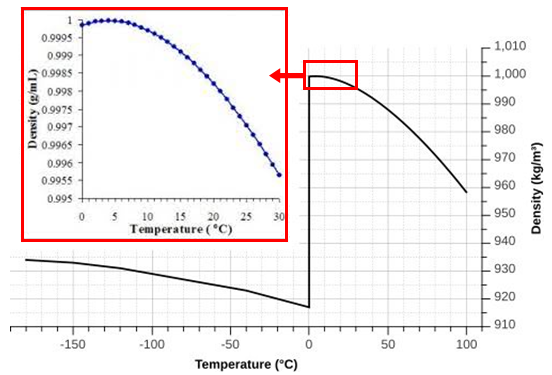
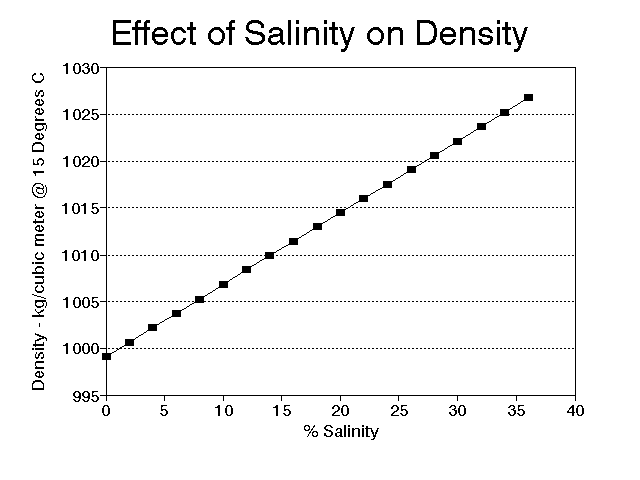
Water is heaviest at a temperature of 4 degrees. So when the upper layer of the ocean in the Gulf Stream has cooled enough, it will sink down. Furthermore, salt water is heavier than fresh water. The mass of water travelling from the Gulf of Mexico to northern Europe will partly evaporate along the way. Salts do not evaporate with it, so the seawater slowly becomes more salty. This is another reason it sinks to the north. So that is why we speak of ‘thermohaline circulation’.
Water is a greenhouse gas and heat buffer
A planet more than half covered by liquid water has a very strong temperature buffer. Most of the solar energy that falls on our Earth ends up on water. The heat capacity of liquid water is very high, at 1.163 Wh/kg,K (Watt hours per kg per Kelvin). So you need to add 1.163 Watts of energy for an hour to 1 kg of water to make it 1°C (= same as 1 Kelvin) warmer. Suppose, for example, that when the sun is full, about 230 Watts per m² of solar energy falls on the sea. A kilogram of water is 1 dm³ in size. One kilogram of water has the volume of a 10 x 10 x 10 cm cube. This cube has a top surface area of 10 x 10 cm (1dm²) and thus receives 2.3 watts of energy at full sun, i.e. theoretically enough to warm up almost 2 degrees in an hour. However, this water constantly mixes with the millions of kg of water below it that receives no solar energy. So in practice, the warming is minimal. So in this way, the Earth has a giant temperature buffer.
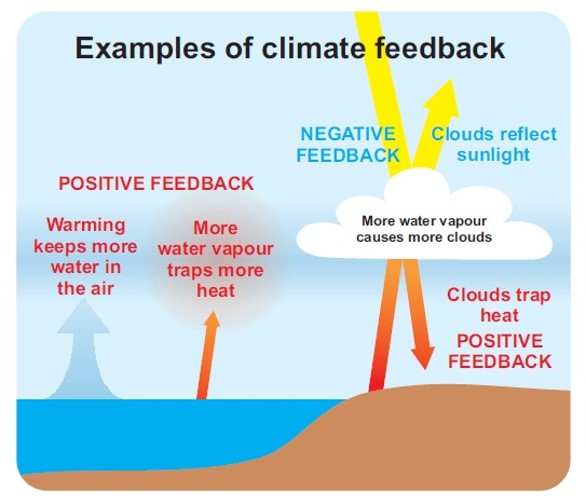
Much of the incident solar energy, by the way, is used as heat of evaporation. Seawater evaporates continuously, supplying the atmosphere with large amounts of water vapour. Water in gaseous form is a very good greenhouse gas. In fact, water is the most important greenhouse gas on Earth. However, the water cycle causes rapid movements between ice, liquid and vapour, so the concentration of this greenhouse gas is variable all the time.
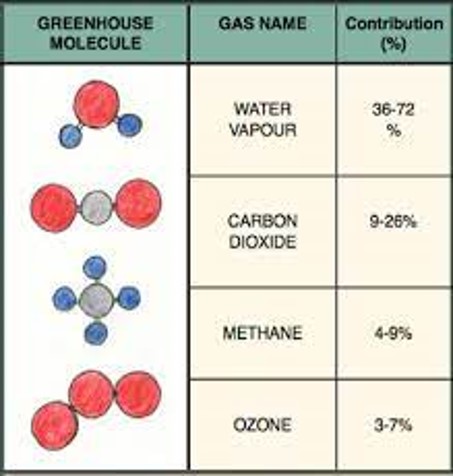
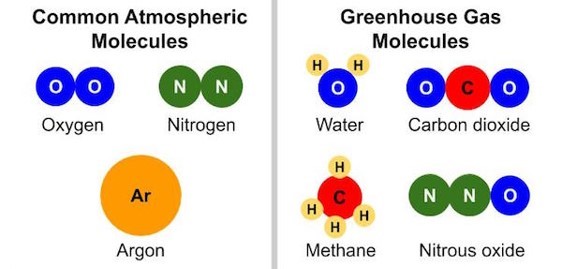
Why is water a greenhouse gas and, say, nitrogen gas is not? Well, greenhouse gases have somewhat more complex molecular structures that form shape and charge variations more easily. These molecules are therefore better able to start vibrating when radiant energy (Infrared heat transfer) hits the molecule. The vibrations partly capture the captured energy in the molecule itself. Oxygen gas or nitrogen gas do not have this characteristic. These are molecules that are symmetrical and very stable in structure, and so can be much more difficult to induce internal vibrations.
Water and climate: negative and positive feedback
On Earth, the behaviour of water can lead to so-called “negative feedback” in some cases. An example is the evaporation of seawater. When it gets warmer, more water will evaporate. As more water vapour enters the air, more clouds will form. But more clouds then create more shade. Less solar heat then falls on the water at the surface and so evaporation starts to decrease again. Because of the reduced evaporation, fewer clouds will then be formed. subsequently, there is less shadow, and you get warming again. So negative feedback is about change slowing itself down. As a result, such mechanisms help prevent extremes.
However, there are also many cases of the opposite: positive feedback, or changes that are self-reinforcing. Some examples:
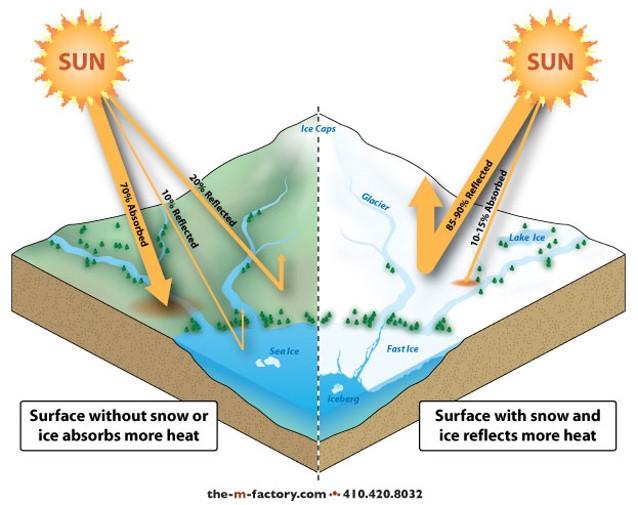
A very well-known one is the albedo effect: As Earth’s climate gets colder, more ice will form at the North Pole and South Pole. Ice and snow are white, and so they reflect more solar radiation than other surfaces. So if there are larger ice sheets due to a colder climate, the total Earth surface is going to reflect more solar radiation instead of absorbing it. This causes the Earth to warm even less, and the climate to cool even more. Thus, a cooling climate can get quite out of control. Our Earth has had periods in its history when this happened. The planet would then have been largely covered by global ice sheets. These episodes are often referred to as ‘snowball Earth’ in popular literature. This will be discussed further in the course.
Water means liveability
It should be clear by now that the presence of liquid water on Earth is extremely important for very many reasons. It is the ideal environment for life to exist and thrive, and to keep the environment within livable limits. Besides the many examples described in previous sections, water also has an important role in keeping plate tectonics active. But that is a topic for subsequent chapters.