

Image in header: A polar water molecule: with positive and negative partial charge. Source: ESA.
We may think of water as very mundane, but it is actually a miraculous little molecule with very extraordinary properties that provide an ideal environment for living cells. In this chapter, we look at what the most essential properties of water are and why they are so important both for living cells and for the viability of our planet.
Water as a solvent
Water orH2Ois a polar molecule. That is, this molecule does not carry equal charge on both sides. The molecule is asymmetric: the hydrogen atoms are along one side, and the free electron pair of oxygen points to the other side. Oxygen tends to pull the electrons of the molecule more towards itself. Therefore, the hydrogen side carries less negative charge. After all, the electrons carry a negative charge, and in a water molecule are more on the oxygen side. You can also say that the oxygen side carries a partial negative charge δ-, and the hydrogen side carries a partial positive charge δ+.

Now, if another negatively charged molecule or atom (i.e. an ion) is thrown into the water, the water molecules around it are going to start directing their hydrogen side (positive partial charge) all towards that ion. They are going to start forming a mantle of water around that ion, so to speak. This is very stable. This is why the ion dissolves well in water. The classic example is table salt or NaCl (Sodium Chloride). In water, this salt will spontaneously split into two ions: Na+ and Cl-. Both ions are then quickly surrounded by water shells, as shown in the drawing above.
Other salts, sugars, etc. also dissolve easily in water in the same way. And the same applies to large biomolecules – proteins, for example – when they carry many ion charges or partial charges on their outside. Or in other words, polar molecules dissolve easily in water. A living cell is essentially a bag of water in which all kinds of chemical reactions take place. As a rule, there is water both inside and outside the cell. The cell then controls all chemical reactions inside the cell and at the boundary with the outside world, the cell membrane. Water is the ideal solvent as a small polar molecule. Moreover, biochemical reactions make great use of the ions that water itself can form: H+ and OH-. The concentration of free H+ ions (= acidity) is then also a very important regulator that determines whether some reactions proceed or not.
Hydrophilic or hydrophobic (water-loving or water-repellent)
However, there are also non-polar molecules, such as fat and oil. So these are molecules in which the electrical charges are just evenly distributed. So they have no partial charges on their sides. The non-polar water molecule cannot form a stable shell around this. In such cases, it is more stable for the non-polar molecules to sit against each other. Therefore, they are very poorly soluble in water. This is why oil stains can exist on water or why grease does not wash off easily with pure water. We call such substances hydrophobic: they do not like water. Certain large fats or proteins have a hydrophilic and a hydrophobic side. In water, these molecules start to stick together with their hydrophobic side, while all the hydrophilic sides point outwards. They can thus spontaneously form microscopic spheres or cells(micelles) without the need for energy.

Membranes
Like soap, there are also biomolecules that have polar heads and apolar tails: phospholipids, for example. In phospholipids, the tails are formed by hydrophobic fatty acids (hydrophobic). Such molecules therefore spontaneously organise themselves into micelles or even larger double layers in water. Those double layers are membranes. All living cells on Earth use membranes of phospholipids as the outer boundaries of their cell bodies. This is incredibly convenient. Most molecules cannot easily pass through the membrane. That’s why the membrane is called semipermeable: permeable only to a few small molecules. This gives the living cell a lot of control over what goes in and out. To regulate it all very finely, proteins are then made that protrude through the membrane, regulating the entry and exit of specific substances like a real border control.

Hydrogen bonds make this substance unique
When many water molecules are next to each other, the positively charged hydrogen sides start to align with the negatively charged oxygen sides. This causes all the water to hang together, so to speak, via so-called‘hydrogen bonds‘. Water is very good at this! Other substances can also make hydrogen bonds, but with water, because of the shape of the moleculeH2O, the entire molecule is completely surrounded by bridges. As a result, a drop of water hangs together well and can lie like a ball on the table. We call this property great surface tension. It has many consequences that are interesting for life on Earth.

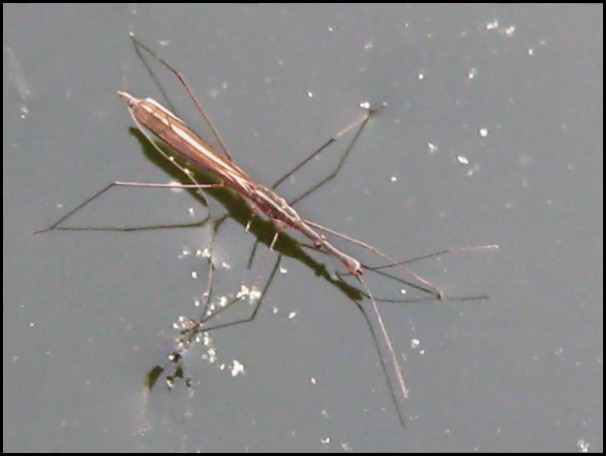
How about capillary effects, for example. If water enters a very thin vertical tube, you will see that water creep up by itself. This is due to the high surface tension. Plants naturally use that to transport water from the soil to their leaves. Also the effect that raindrops stay on everything. For example, on tree leaves in the rainforest or in pores of soils or rocks. Without that large surface tension, those drops would flow away. Of course, that helps keep a biotope from drying out quickly. And the next time you see a scribbler or stick insect walking on water: know that is possible thanks to high surface tension.
Another effect has to do with evaporation. Because of the hydrogen bonds, a very high amount of energy is needed for water molecules to escape from the liquid to the air above. This high evaporation energy prevents too rapid dehydration, but can also, for example, actively cool a body when it is too hot. If our sweat glands wet our skin, the evaporation of that sweat will extract a lot of heat energy from our skin, and we cool down well.