

Image in header: Combined image from ALMA (red) and VLA of HL Tau. This star is similar to the Sun, and its protoplanetary system is younger than 100,000 years old! Source: Carrasco-Gonzalez, et al; Bill Saxton, NRAO/AUI/NSF.
A living planet like Earth cannot, of course, occur anywhere in the Solar System. First, we are talking about an Earth-like planet. As we have already briefly discussed in item 0.3, for that you have to be in the innermost part of your planetary system – between the star and the ice line – because further out, gas giants are formed, and not terrestrial planets. Second, you have to be in the habitable zone, because that is the zone where water can occur in liquid form because it is neither too hot nor too cold. We will take a closer look at both conditions.
Earth-like planets within the ice line
In item 0.3, we explained that in a young planetary system, there is a so-called ice line. Between the star and the ice line it is warmer – because closer to the star – so volatiles are in gaseous form. Further from the star, beyond the ice line, it is naturally colder, and those volatiles are frozen (water, methane,CO2 and CO, ammonium, …). There, they form ice crystals that sometimes clump together in chunks. In fact, each substance has its own ice line: the distance from the star where it passes from vapour to ice. But broadly speaking, that ice line for our solar system was between Mars and Jupiter. Hence, the inner planets are much smaller: most of the gas was driven outwards by the solar wind, so much less matter remained within the ice line. Therefore, the inner planets contain mostly material that did not evaporate in this zone: metals and silicates. So they are rocky planets. the outer planets, on the other hand, are much larger, swallowed much more matter, but for the most part they also contained volatiles, much more than metals and silicates.
Icy pebbles migrate indoors
Of course, reality is much more complicated than the simplified version described above anyway. There are also young planetary systems where things are slightly different after all.
The frozen volatiles outside the ice line form small ice pebbles (in English: Icy pebbles) in which water is the most abundant substance. But the pebbles usually contain other volatiles, as well as some metals and silicates. We know that in young planetary systems, those pebbles migrate inwards because they move faster than the surrounding gas. As a result, they collide with the gas, causing deceleration. Those decelerations cause loss of angular momentum. And as a result, the pebbles start to reduce their orbit around the star: they slowly move to a lower orbit. Moreover, the star’s gravity acts more on the pebbles than on the surrounding gas.
As the pebbles migrate inwards, they end up within the ice line, and there they start to evaporate. As a result, rocky planets still form in a zone where volatiles are available again, although it is still markedly less than in the outer zone.
Now, it is true that the inward migration of the ice pebbles can be firmly slowed down when they land on the orbit of a forming giant planet. After all, a forming giant planet (still outside the ice line) creates an orbit with increased gas pressure. The pebbles get stuck in that ring of higher pressure in part because they collide with it. As more pebbles linger there, that giant planet will be able to gobble up even more material, and grow even faster. And as a result, that faster-growing planet will provide even more orbit with higher gas pressure, etc.
The extent to which migrating pebbles are slowed down on planetary orbits outside the ice line, very much determines the nature of the planets inside the ice line. In our Solar System, for example, we see that the inner planets are rocky planets with relatively little water. Apparently, the migration of pebbles in our Solar System has slowed down pretty well on the orbits of Jupiter, Saturn, Neptune and Uranus. This is typical of so-called extended disks. By disk here we mean the disc of dust and gas around a star in which planets are formed. In extended disks, we see clear ring structures of large planets beyond the ice line, where pebbles are slowed down. There are also systems with compact disks, such as the TRAPPIST-1 system. In these, we see much less or none of these ring structures, so the inward migration of pebbles is much smoother there. In systems with compact disks, the later rocky planets contain much more water, and they are larger. If they get too close to the star, they do lose that water through evaporation, and if they are too far from the star, their water gets frozen. But if you are at a safe distance in such a system, chances are you end up as a ‘water world’. This is a rock planet with a large water mantle around it, a super-ocean. In certain in similar to the ice moons around jupiter, but without a frozen crust. We are then talking about planets that have one big ocean around them 100 or more kilometres deep!
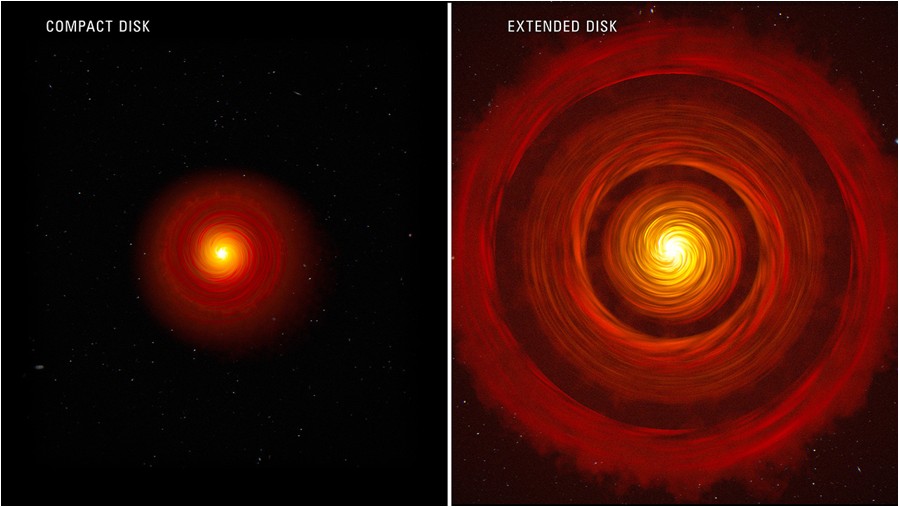
The TRAPPIST-1 system sits around an ultra-cool dwarf star, and so it was possible there that several planets formed very close to the star. So there, a compact protoplanetary disk led to a series of very water-rich planets. Around our star, the Sun, that would not be possible. Our disc was of the extended type. And fortunately so, because otherwise the Earth would have true water. The oceans would be so deep that an ice sheet might form at the bottom. This is possible at very high pressure with ice of particular types. All the aspects that have ensured livability on our planet all this time – plate tectonics, deep-sea volcanism, atmospheric equilibria, livable pressure and temperature, sufficient land, etc. – would have been compromised. So it is not enough that your planet is formed within the ice line. A lot of other factors matter.

Habitable zone
And then if you were lucky enough, and thus became a rocky planet with neither too much nor too little water, so you must also be in the ‘habitable zone’ around the star. That is the region where it is neither too hot nor too cold, so water can also occur in liquid form on the surface. In our Solar System, we happen to have a rocky planet on the hot frontier, on the cold frontier and in the middle of the habitable zone. We will take a closer look at this in the next entry.