

Image in header: As on Earth, on other planets with a magnetic field, we can see the northern or southern lights at the poles. Here we see it at Saturn’s south pole. Source: NASA/ESA/STScI/A. Schaller.
Earth is not the only planet with a global magnetic field. Mercury also has one (albeit weaker), and almost certainly Venus and Mars also had such a field in their infancy. Jupiter and Saturn have a very strong magnetic field, and so do Uranus and Neptune but weaker ones. Other than that, there is only 1 moon that has a clear magnetic field, and that is Ganymede, Jupiter’s largest moon. But each of these cases is unique in its own right. We briefly go over the most important ones below.
Mercury
Today, Europe has its own space probe to investigate Mercury closely – namely Bepicolombo – but it is currently aug 2025) still on the way. We are very much looking forward to learning more about this planet when our probe gets close. Voolropig we have to make do with data from the US probes Mariner 10 and MESSENGER. These have both detected an unmistakable planetary magnetic field in their survey of Mercury. This north and south pole of this field were found to be directed towards the geographic poles as on Earth. These measurements and various modelling of the planet suggest that, like Earth, Mercury has a liquid outer core of nickel and iron, which acts as a geodynamo.
Venus
Models suggest that Venus would have had a magnetic field in the first billion years, thanks to convection in the core driven by accretion heat. After that, the field may have disappeared because not enough heat remained. Today, there is no meaningful planetary field (it is 25,000 times weaker than Earth). That the planet rotates too slowly, and therefore lacks a magnetic field, is up for debate. The surface is too hot to preserve remnants of the early magnetic field in the crustal rock, so nothing of it can be detected. We depend on computer models for studies of the history. We know very little about it.
Mars
The same applies to Mars too: accretion heat initially enabled a liquid iron-rich core, giving the planet a magnetic field. But the tiny planet cooled rapidly, and the heat source in the core became too small. The core would also have solidified (almost) completely, and so there is no (sufficiently) liquid outer core. These kinds of properties were actually supposed to be tested by the Belgian LaRa instrument on the lander of the European ExoMars rover. But that craft’s trip to Mars was eventually postponed until 2029. About the historical magnetic field of mars, we do have remaining traces. Today, there are still magnetised regions in the crust as remnants of the former global field. These regions still act somewhat as local protection from solar wind. However, the planetary magnetic field is 5,000 times smaller than Earth’s. The local magnetic fields in the crust are 10 times smaller than Earth’s.

Magnetism on moons
As far as we know, there is only 1 moon in the solar system that has a global amgnetic field. It is about Ganymede, Jupiter’s largest moon. This is a so-called Galilean moon, a large ‘ice moon’, i.e. with a mantle composed mainly of water, and a stone core. How the global magnetic field is formed here is markedly different from the geodynamo on Earth, but derives from the same principles. The warm stone core creates convection cells in the water mantle, and the Moon’s rotation creates the ‘corkscrews’. This then assumes that there is enough flowable water between the ice crust and the core. Much study is still needed to get a better picture of the interior of Ganymede. Fortunately, Europe (ESA) has sent a probe that will travel to Ganymede after several revolutions around Jupiter, and continue to orbit this moon. it is about d eJUICE probe, which we will discuss in more detail in part 5 of this course.

The major planets
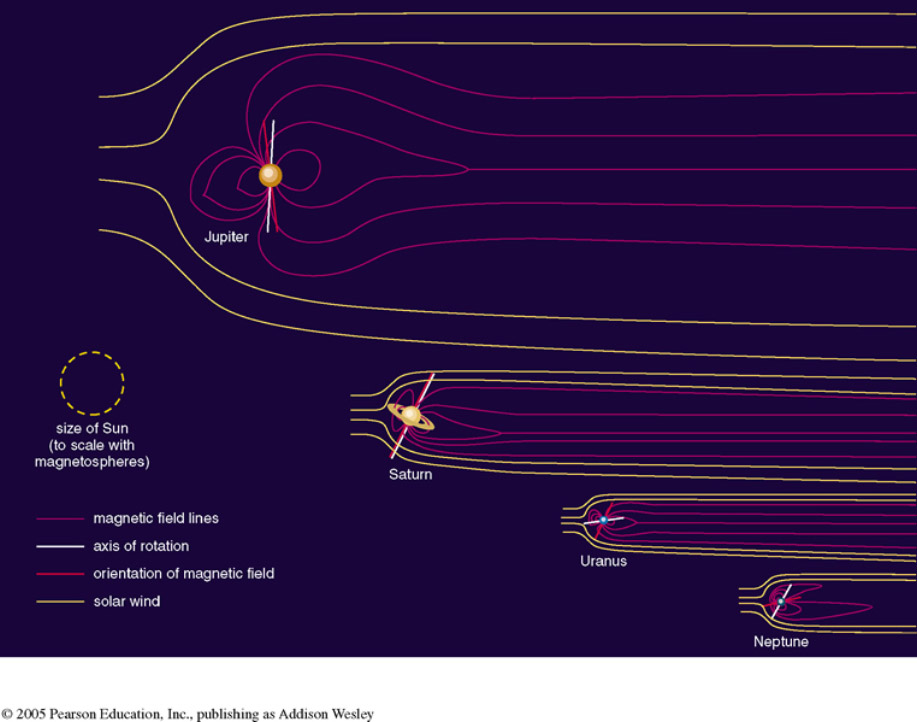
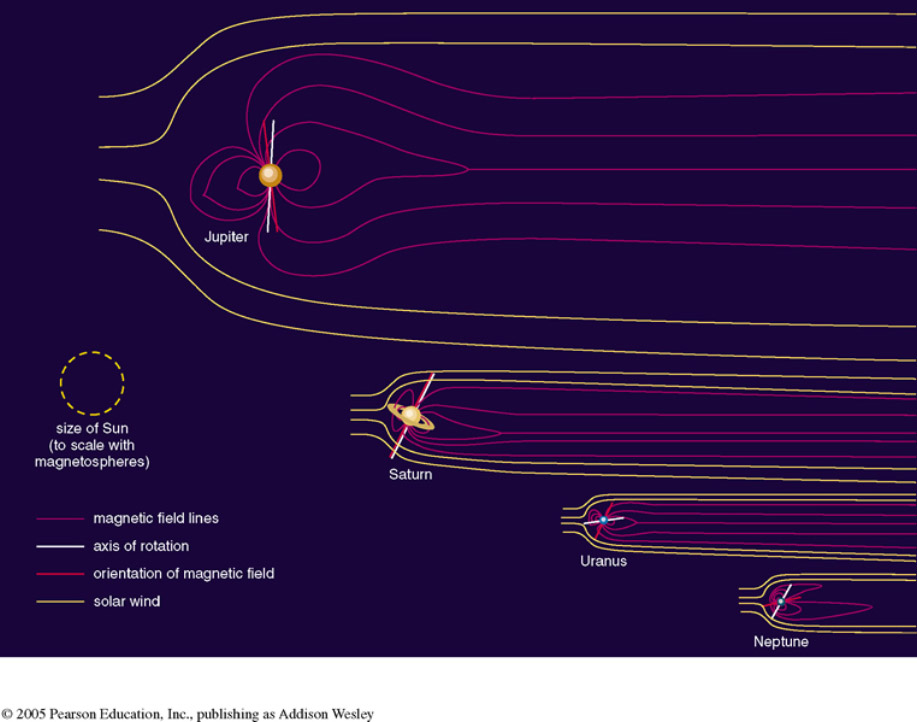
Jupiter, Saturn, Uranus and Neptune all have fairly strong global magnetic fields. Again, this is not a geodynamo arising from an iron-rich liquid core. The moving charges here are formed by metallic hydrogen in a plasma inside the planet (under very high pressure). Since the major planets of the solar system themselves are not contenders for finding extraterrestrial life, we will not discuss their magnetic fields further here. Do know that – especially for Jupiter – these magnetic fields are huge invisible ‘objects’ in the Solar System. The icy moons that dwell in them are very important in astrobiology, though, and their environment is largely determined by the magnetism of their parent planet. We discuss that too in more detail in Part 5.
Decision
A global magnetic field occurs on some celestial bodies and not others:
- Terrestrial bodies: Earth yes, Mercury too but less so, Venus & Mars & the Moon no.
- ice objects: Ganymede does, all others do not
- Gas and ice giants: all have a strong magnetic field
The first two categories are relevant to our search for life. There, it appears that Earth is the most ideal case. Venus and Mars have lost their habitability, and for Mars, the loss of the global magnetic field has certainly played a role in that.