
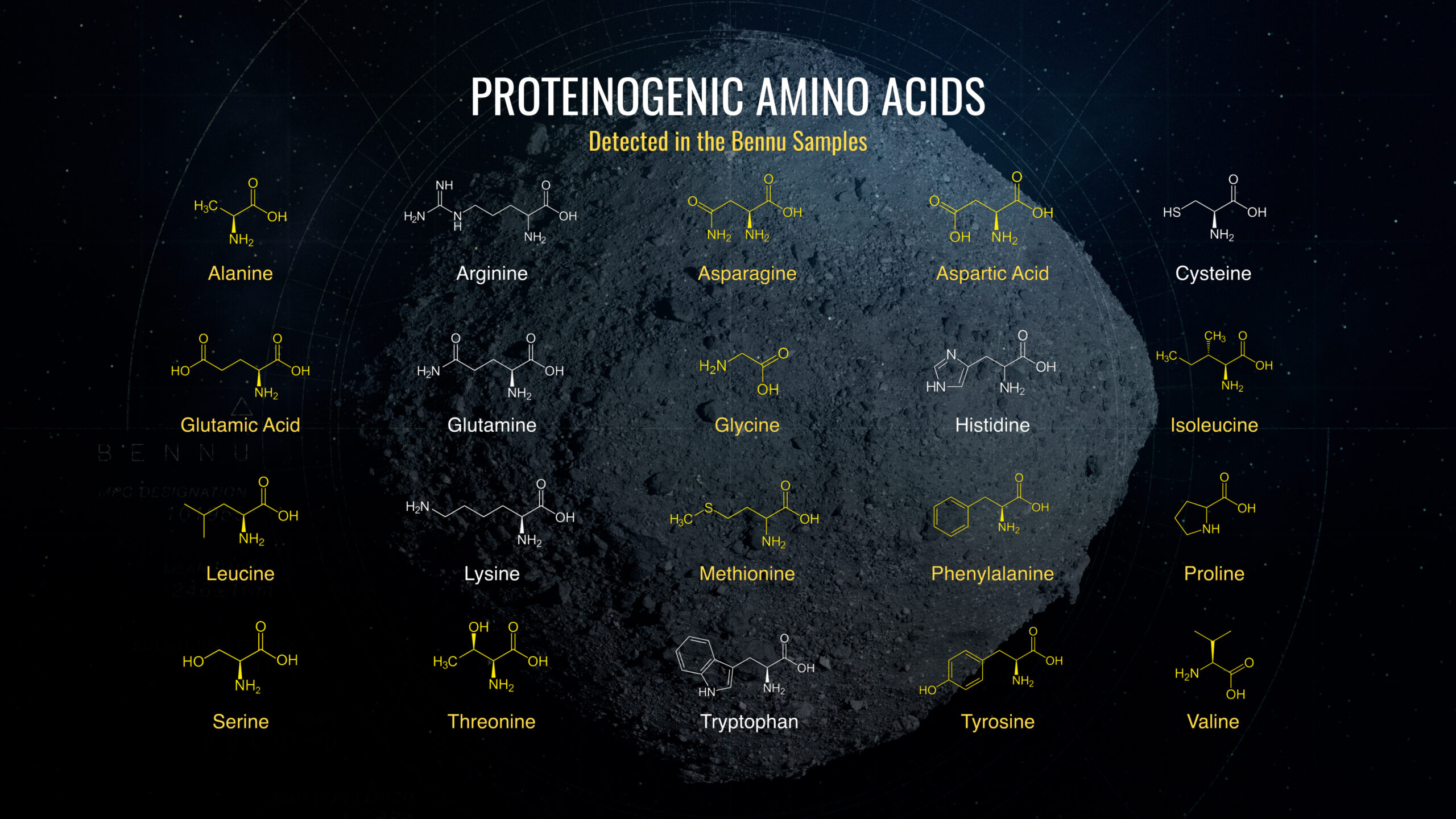
Image above: 14 amino acids found in the sample from Bennu. Source: https://svs.gsfc.nasa.gov/14772/
Flore Van Maldeghem
Primitive asteroids record the processes that took place during the formation and evolution of the early solar system. Such is the case with the asteroid Bennu, which NASA mission OSIRIS-REx reached in 2020. They managed to collect 120 grams of Bennu’s surface and return it safely to Earth on 24 September 2023. The first results are now starting to come out.
Two studies have recently been published in the scientific journal Nature and Nature Astronomy. On the one hand, molecules have been discovered that, on Earth, are key to life; on the other, evidence has been found for the presence of salt water, which could serve as a medium for these molecules to react and combine. This is not evidence for life itself, but does suggest that conditions for life on were present at different places in the early solar system.
More than a thousand organic molecules were identified, including 14 of the 20 amino acids that make up proteins on Earth and the five nucleobases, or the letters A C G T and U that build DNA and RNA. These nucleobases store and transmit genetic information in the complex DNA and RNA molecules. High concentrations of ammonia have also been discovered. Ammonia is important for biology because in reaction with formaldehyde, also discovered in Bennu’s material, it can form complex molecules such as amino acids. When these amino acids are linked in long chains according to the information found in the genetic information in RNA and DNA molecules, they form proteins that drive almost any biological function.
A second study focused on the environment in which these molecules formed by studying the minerals present. They describe traces of 11 minerals in Bennu that crystallise when water evaporates such as halite, calcite and sylvite. Similar minerals have already been discovered in meteorites but not in such a complete set as on Bennu formed during an evaporation process of thousands of years. Some minerals such as trona have been found for the first time in extraterrestrial samples.
The discovery of these building blocks of life in such a pure material as Bennu supports the theory that objects formed far from the sun could be an important source of these building blocks for life in the solar system. But as often with scientific discoveries, many questions remain.
For instance, many amino acids occur in mirror shapes, with right-handed and left-handed variants. Life on Earth consists mainly of left-handed amino acids, but an equal mix of both forms was found on Bennu. Would this also have started this way on Earth? And then why is there a preference for the left-handed variant?
Impacts from asteroids like Bennu may have supplied the Earth with water and organic material. But was this in high enough concentrations or was this mainly a start-up for processes that were already underway?
More answers, and questions, will undoubtedly come in the coming years from further investigation of Bennu’s material.
Source : https://www.nasa.gov/news-release/nasas-asteroid-bennu-sample-reveals-mix-of-lifes-ingredients/