
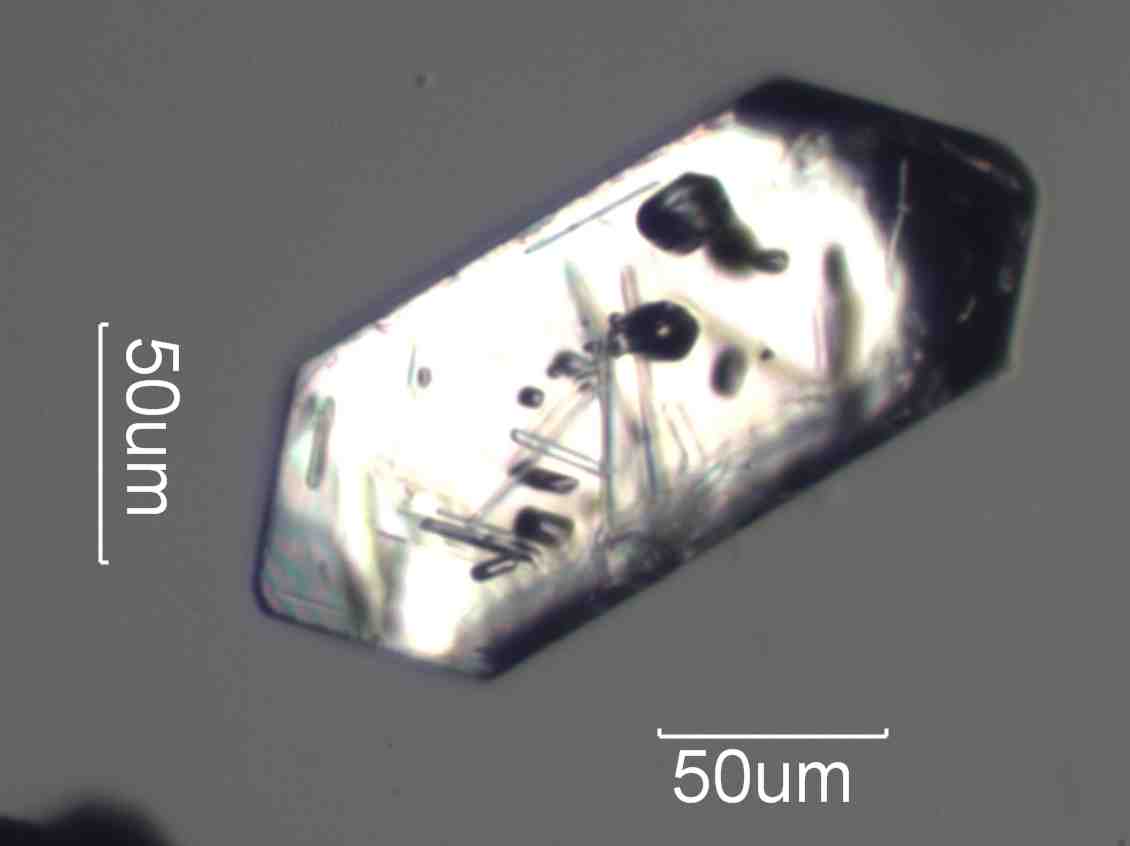
Image in header: A zircon crystal with inclusions of impurities from Stonefield Beach in the Pacific. From Microlabgallery.com.
Zirconium as a messenger from a distant past
Zircon crystals (Zirconium silicate or ZrSiO4) are found just about everywhere on Earth, both in sediments and volcanic rocks. This is very nice for scientists for two good reasons:
- These crystals are enormously resistant to weathering. They are so tough that they remain unchanged even after they have been absorbed into the Earth’s mantle along with the surrounding rock and then returned to the surface via erupting volcanoes. So they are the only older remains when all the surrounding rock has completely disappeared through geological activity.
- They usually contain impurities, small inclusions that contain information about Earth’s crust that has already disappeared.
In Western Australia in particular – Jack Hills – zircon crystals have been found that are more than 4 billion years old. The rocks in which they originally occurred have all but disappeared, so these crystals really are the oldest pieces of Earth’s crust still in existence. They must have formed under high pressure from the action of early plate tectonics or possibly from impacts of large meteorites. Dating based on uranium-lead and thorium-lead ratios has shown that the very oldest crystal is 4.404 billion years old. By comparison, the Earth itself is 4.56 billion years old. The contents of that oldest crystal were thoroughly examined. This allowed them to estimate the environment in which the crystal formed, especially based on the oxygen isotopes. The researchers concluded that the crystal formed “in a relatively calm water world with relatively low temperature”. In other words, only 160 million years after Earth’s formation, a solid crust covered with ocean had already formed. A layer of liquid water whose temperature remained below the boiling point.
Turbulent times
Back then, Earth did get bombarded very heavily at times with debris from space. The Solar System was still forming, and there were a lot of collisions going on. A lot of asteroids were in unstable orbits or on a collision course with other objects. Debris was flying just about everywhere. Some impacts might have suddenly vaporised the upper layer (100 metres) of the oceans, driving up the air temperature to as much as 500°C. Then the cooling had to start all over again. This will have been even more intense with the very largest collision. By this we mean the collision between Earth and Theia. Theia was estimated to have been the size of Mars, and this collision left us with the Moon. Despite this, we think the Earth’s crust and oceans were able to fully recover in 5 million years. More on the Moon formation later.
Could life have arisen back then, in that alternation of calmer oceans and turbulent hellish times? The deep sea was possibly a fairly stable and safe place. It could be, but we really don’t know. One rare Jack Hills zircon crystal is dated at -4.10 GA (+/-0.01 GA), and contains graphitic carbon completely surrounded by undamaged crystal. So this carbon was definitely incorporated into the crystal at that time of formation. When you go to examine the ratio of istopes 12Cand 13Cin this graphite, it turns out that it contains the typical ratio of living tissue. So this is a nice clue that life could have already arisen in that Hadean ocean. Simple single-celled organisms that may have disappeared again due to large meteor impacts, after which life re-emerged. Alternatively, these cells simply persisted in the deep sea, thus forming the ancestors of all current life on Earth. Such secrets, unfortunately, cannot be revealed in crystal research.
A water world
In any case, there was a solid crust with an ocean on top. Divergent isotope studies confirm this, by the way, as explained very well in Springer’s book “Young Sun, Early Earth and the Origins of Life” (2012). In the beginning, the Earth would have been almost completely covered with water, with a volcanic top here and there above the water surface. So the crust was under water and was entirely oceanic crust for the first hundreds of millions of years. Continental crust is less heavy, so after a long time it forms a thick packet of scraped-off upper layers where the rock dives back into the mantle. Meanwhile, the amount of water also continued to increase due to volcanic outgassing of water vapour and the addition of impacting water-rich space debris. Throughout the Hadean era (-4.56 GA to -3.9 GA), the Earth would therefore remain completely covered by ocean, albeit with many active volcanoes rising above the water. After that, the continents began to get bigger and bigger, but it took a long time before the got big enough to form dry land above the ever-deeper seas. For the first one and a half billion years, the land surface remained much more limited than today. But afterwards (Proterozoic and Phanerozoic), the land-to-sea ratio was probably not very drastically different from today’s 29%/71%. And that is just as well, because we will further see that this ratio is important for avoiding overly large and dangerous climate fluctuations. This is one of the many factors where the livability of our planet has always been preserved during these 4 billion years.


Whether all that water came mainly from the outgassing of Earth’s rocks or rather from the millions of water-rich asteroids and even more water-rich comets that struck the young Earth is still an unfinished debate in science. There is a lot of evidence to suggest that both sources were important. But for now, no one can be conclusive about the correct proportions.