Image in header: Antarctica ice and cirrus clouds. www.sciencephoto.com.
Behaviour of water on Earth and elsewhere
We were always taught that water freezes below zero degrees Celsius (or < 273 Kelvin) and boils at 100°C (or 283 Kelvin). That is how water behaves here on Earth, where there is continuous atmospheric pressure of about 1000 mBar. In our observatory in Ghent, we have a vacuum clock. During school visits, we sometimes put a simple glass of water under that clock, and we pump out the air. The glass of water is then in an air pressure of about 30 mBar. That is not a complete vacuum, but it is enough to bring the water to a full boil. The children are then surprised when they feel the water afterwards, that it has not warmed up at all, even though they clearly saw it boiling.
So water behaves differently under different atmospheric pressure. On Mars, for example, there is an average atmospheric pressure of 6 to 7 mBar. That pressure is so low that a melting ice cube immediately starts boiling. The melting ice has no time to form liquid water first. This happens immediately on Mars when the temperature rises above 0°C (or 273 K), which happens frequently in equatorial regions. No liquid water can therefore be found on the surface.


On the Moon, the atmospheric pressure is even more extreme, at 0 mBar. In these conditions, we actually see water ice boiling away (sublimating) at any temperature. However, the rate at which water ice sublimates in vacuum is enormously slow at very cold temperatures such as, say, -100°C (=173K). At the Moon’s north pole and south pole, there are deep craters where sunlight never touches the bottom: “craters of eternal darkness”. Since there is no air there to transport heat either, the bottom of those craters is always colder than -230°C (=43 K). In those conditions, the sublimation of water ice is so slow that it can remain largely there even for billions of years.

From the above phase diagram of water, it is easy to see that the Earth easily admits the three phases of water because of its atmospheric pressure and temperatures. This is in contrast to the Moon (which is the same distance from the Sun) and Mars. However, if we want to estimate what it is like in other places in the Solar System, we need to expand the whole diagram. After all, there are places with much hpgere pressures and also sometimes very high or low temperatures.

The extended phase diagram of water above shows some zones applicable to the ice moons Europa and Ganymede. Many of these ice moons are believed to have an ocean of liquid water beneath the crust of water ice. For the moons Europa (Jupiter) and Enceladus (Saturn), this has since been proven by space probe studies. We also know that those oceans have contact at their bottoms with a geologically active rock core, and this is important for potential life. This might be different for very large ice moons like Ganymede (Jupiter) because of the enormous high pressure at the bottom. At such high pressures, you can expect the water to become ice again, but type VI ice (see diagram above). This is a type of water ice that is heavier than liquid water. Therefore, we suspect that at the bottom of the subsurface ocean on Ganymede there is a layer of ice. The ocean then has no direct contact with the rock core. This makes this underground ocean less interesting for our search for life. More on this will follow in part 5 of this course.
Liquid water: where in the Solar System?
In our search for life in the Solar System, we want to look for places where water occurs in 2 or 3 phases, with liquid water definitely among them. In summary, we can expect to find it in the following locations:
- Surface of Earth: ice, liquid, vapour.
- Subsurface of Mars: ice, liquid.
- Large moons and dwarf planets in the outer Solar System: ice and liquid in an underground mantle and possibly liquid water in holes and crevices of the ice crust.
All other locations in the Solar System are therefore much less interesting to go looking for actual life. This does not mean that there is no water there. On the other planets, moons, asteroids and comets, water is usually present, sometimes very much so, but only in ice or gas form.
Furthermore, we should also conclude that the Earth’s surface is by far the most favourable situation, where water is frequent, permanent and abundant in all three phases.
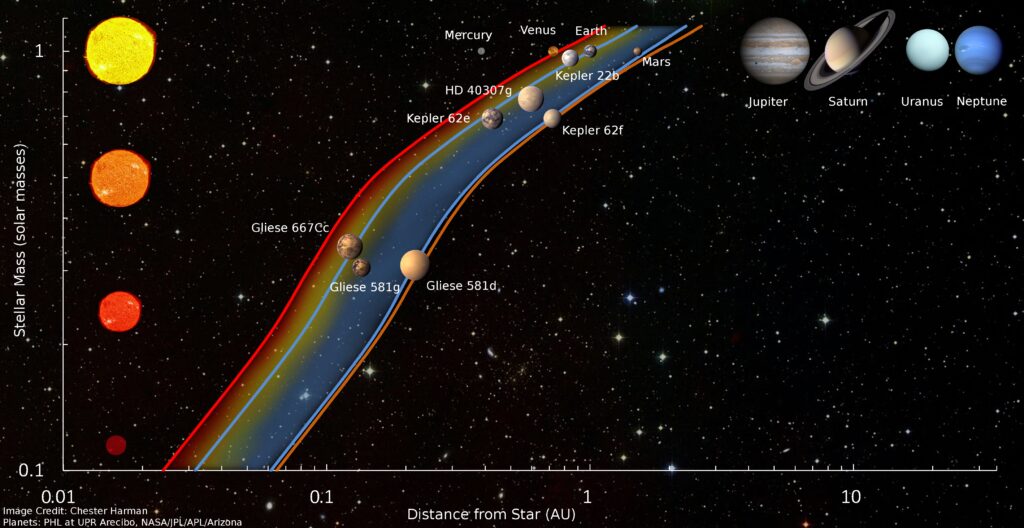
The habitable zone for planets
It is rather obvious which are the main conditions for the occurrence of water in the three phases to be possible on a planet: it must not be too cold and not too hot. Thus, you can calculate the ideal distance for its planets from any star and thus determine the ‘habitable zone’. If we do that for our Sun, we arrive at a zone in which 3 planets can be found: Venus, Earth and Mars (and Earth’s large Moon). Venus is admittedly very close to the ‘too hot’ boundary, and Mars is on the ‘too cold’ boundary. Earth and Moon are in the comfortable middle zone. So we see four major celestial bodies within the ‘habitable zone’ around our star, but only 1 of them has true habitability today. So this is a very important lesson when yet another news appears about an ‘Earth-like’ exoplanet around another star within the habitable zone. There can be a lot of reasons for finding an unlivable planet within this zone anyway. For Venus, it was an out-of-control greenhouse effect (runaway greenhouse), for Mars the loss of its atmosphere, and for the Moon the absence of an atmosphere from the start. Too little geological activity, for example, could also be a problem. Those kinds of important characteristics for living planets will be discussed in more detail further on in this course.