
Besides liquid water and the necessary elements and molecules, the availability of energy is also essential to make life possible. In our Solar System, energy usually comes from three possible sources:
- Radiant energy of a star, namely our Sun
- Tidal energy due to gravity variations
- Internal planetary heat
On Earth, we are used to most life thriving because of Solar energy, but internal heat of the planet also plays an important role, as we will explain several times in this course. In the search for extraterrestrial life, the three energy sources above are very important.
Radiant energy of the Sun
Earthly life came up with a new and very efficient form of metabolism quite soon after its emergence, namely photosynthesis. As a result, life pretty soon had a major impact on the further evolution of our planet by producing biomass and oxygen gas. More than two billion years later, photosynthesis became the big engine behind the production of a lot of biomass, and complex and multicellular life became possible (plants and animals). Today, we live on a planet with a very impressive biodiversity and the whole surface is covered and influenced by untold numbers of life forms. No other planet in our Solar System has ever known such diversity, that much is certain.
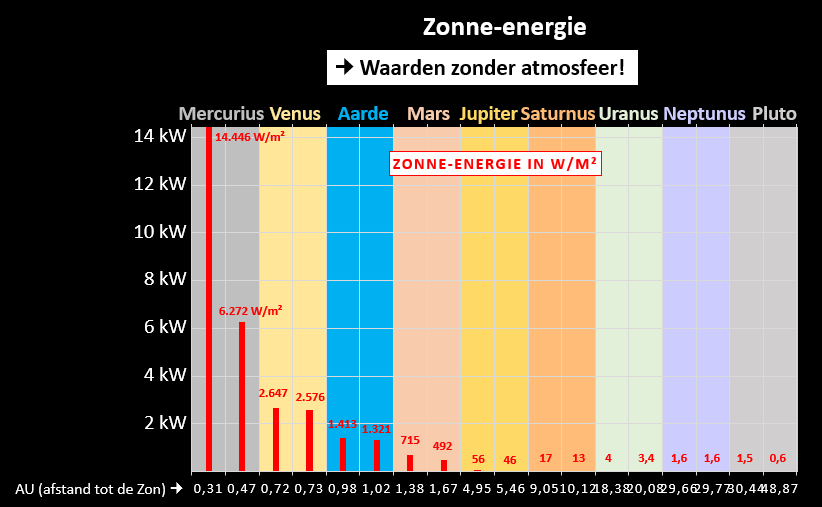
However, there is no shortage of sunlight on the rocky planets Mercury, Venus, Earth and Mars. The graph below shows how much sunlight each of those planets receives on average before solar radiation passes through the atmosphere, and when it strikes the surface perpendicularly.
On Mars, we see that the amount of solar energy is approximately half that of Earth. That is still more than enough for photosynthesis as we know it on Earth. So there are other reasons why it never came to an equally impressive amount and diversity of life on Mars.
On the outer planets (gas giants and ice giants) and their moons, there is much less solar radiation. Consequently, it is particularly cold there on the surface. However, it is not impossible that there would be life there, as there are other sources of energy.
Tidal energy
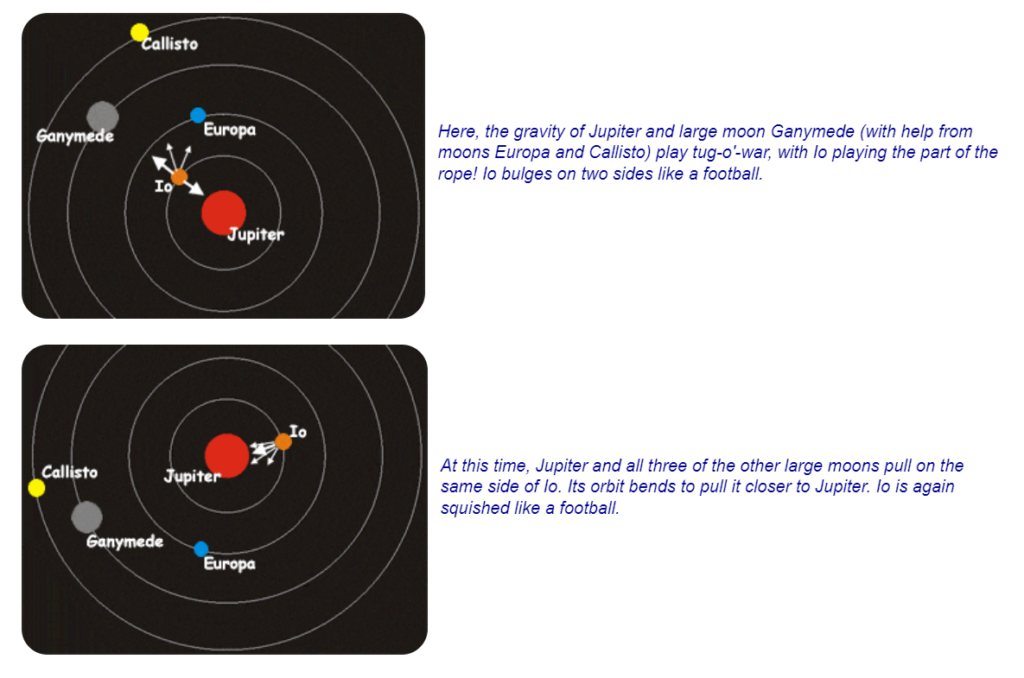
We know tidal energy on Earth mainly because our big moon pulls the surface water (the sea) a little in its orbit, causing ebbs and flows. The Earth’s crust also varies in height due to the lunar tides. Sea tides have played a fairly limited role in the evolution of life on Earth. There are, however, other reasons why our big moon was so important in our history. More on that later.
Tidal power only becomes really important in places where solar power is very low.
The first revealing images of the icy moons around Jupiter and Saturn came from Nasa’s Pioneer and Voyager missions from the 1980s onwards. The surfaces of these moons turned out to be much less dull than expected. One saw surfaces of frozen water at about -180°C. But more interestingly, all sorts of patterns could be seen on those surfaces. It looked like there must be some kind of dynamics. Was this geological activity? Was there perhaps something liquid under that layer of ice? Scientists came up with explanatory models that were later confirmed by better observations. We take a quick look below at the Jupiter system with its four largest icy moons, namely the Galilean moons Io, Europa, Ganymede and Calipso. These are the four moons you can see with simple and small binoculars when Jupiter appears in the night sky.
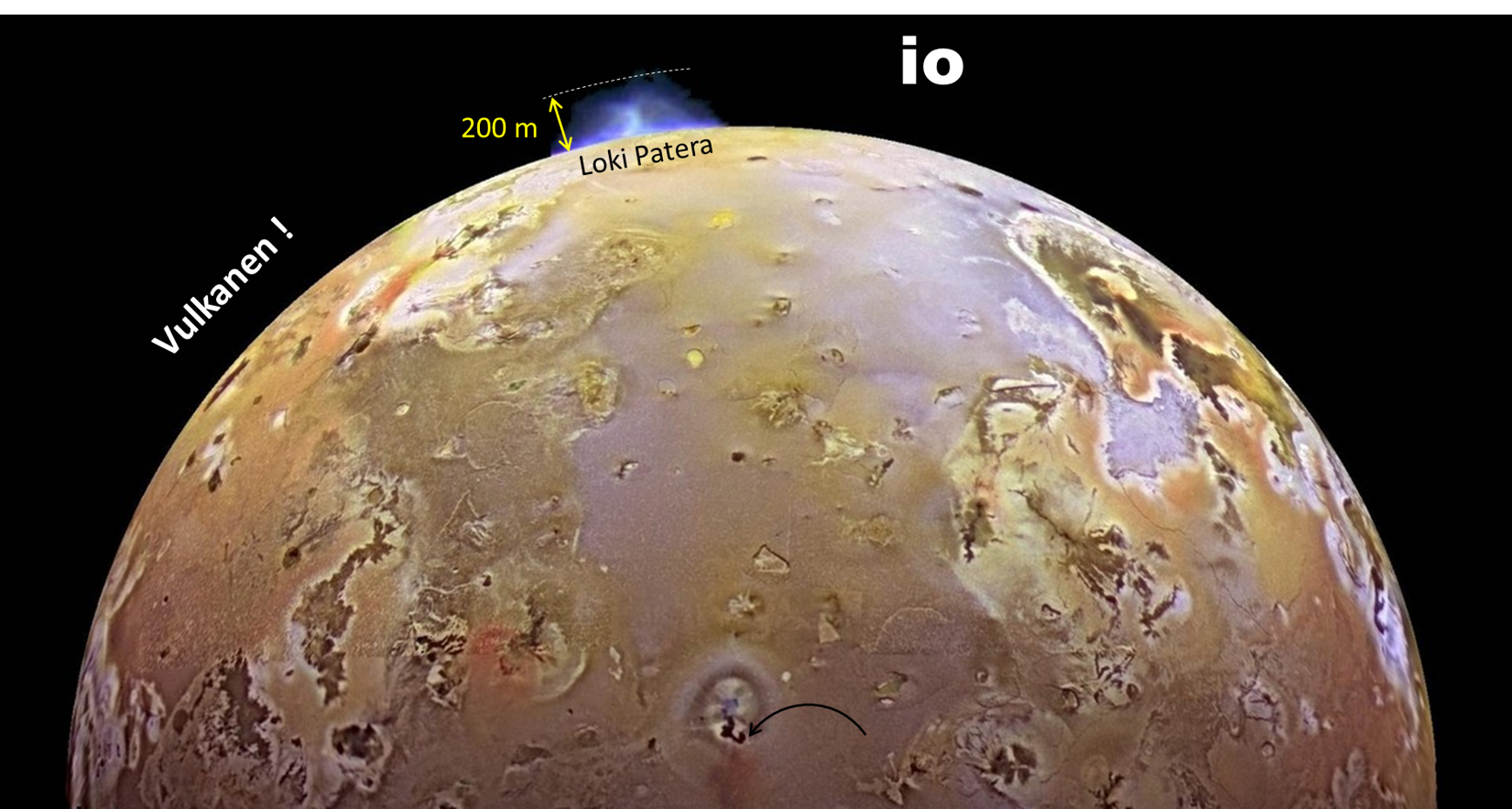
The moon Io shows what the core rock of an ice moon looks like when the water mantle around it has disappeared. Io is the only moon in our Solar System with volcanism. There are constantly erupting volcanoes and lava flows all over its surface. A picture of this is in the header above this text.
Internal heat of the planet
Planets and other large objects accumulate several internal heat sources as they form:
- Accretion energy: that is kinetic energy converted into heat when planet-forming debris collides.
- Heat from radioactive decay of less stable elements.
- Frictional heat in internal differentiation: when heavier elements sink to the centre and lighter ones to the outside due to gravity.
How fast a planet subsequently cools depends mainly on how much heat these 3 sources generate, and on the surface-to-volume ratio and thus the size of the planet.
Internal heat plays a very big role in the living Earth throughout the planet’s history, and also in the emergence of life. This is all discussed in detail in the course. In any case, this distinguishes Earth from Mercury, Mars and the Moon. The latter three cooled down until they were ‘geologically dead’.