
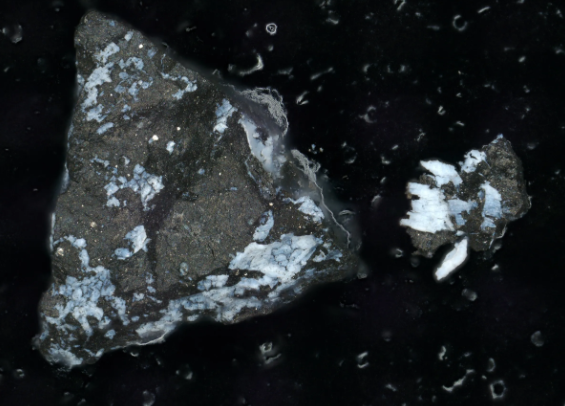
Source: Nasa / Lauretta et al (2024) / Universe Today
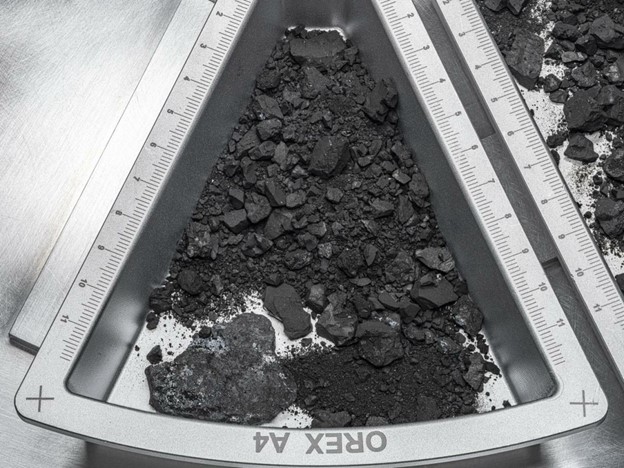
In autumn 2023, NASA’s OSIRIS-Rex probe returned the impressive sample of 121.6 grams of pure asteroid dust to Earth. The sampled asteroid is Bennu, a primitive carbonaceous chunk of space debris 490 metres in size. What do we learn from the initial surveys on this sample?
Bennu is very carbon-rich (almost 5% by weight) and nitrogen-rich. It also contains quite a lot of organic matter. Its elemental composition is about the same as the Sun, so it is representative of the primordial material from which the Solar System was formed. The minerals are original, they were not formed from molten rock that was re-solidified.
The sample contains many clay minerals, especially serpentine, as well as carbonates, iron sulphides and iron oxides, and water-soluble phosphates. These are strong indications that this matter originated in a water column: an ocean world! It is a typical composition of a place where magma comes into contact with water on the seafloor, such as terrestrial hydrothermal vents. Other options have not been completely ruled out, but the water-world hypothesis is certainly the most likely.
The discovery of the water-soluble Mg-Na phosphates is most remarkable. In the Bennu samples, these are very pure and clearly concentrated, unlike the phosphates found in the Ryugu sample from Japan’s Hayabusa-2. This phosphate, as well as other minerals found, were presumably deposited in hydrothermal springs. Moreover, this kind of Mg-Na phosphate is mainly biologically produced in terrestrial hydrothermal. By the way, this phosphate was not detected in situ by the OSIRIS-Rex probe. So this really did require a sample return.
So we can ask how many ‘worlds’ there were in the early days of the Solar System on which oceans of liquid water occurred. We know that early Earth and Mars were habitable places with lots of water on the surface, and very likely Venus too. But in early stages there may have been many more. One of the exciting questions here is: what role did these water worlds play in the emergence of life in our Solar System?