
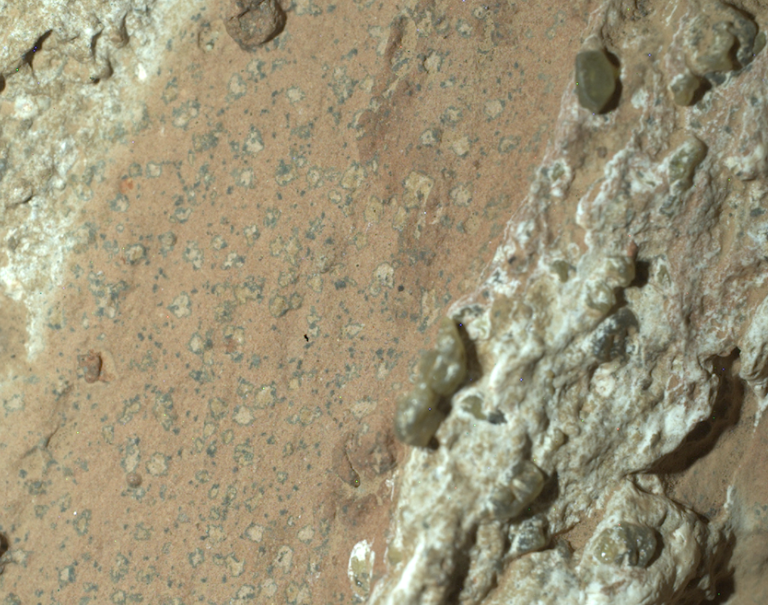
Source: NASA
Sample 22 from Perseverance is a sample that scientists are hugely looking forward to exploring on Earth after the Sample Return mission (planned in the early 1930s). It has so far the greatest potential to discover fossil traces of life. Below we summarise why.
Thoroughly investigated with SHERLOC and PIXL
The sample was studied day and night with Perseverance’s these two instruments. Perseverance cannot do more than this on the ground. So it promises to get really interesting only when the sample is sent to Earth, which is planned within about eight years via a European return mission. At the bottom of this post is a very brief summary of what SHERLOC and PIXL can observe.
The rock where the steel comes from: Chevaya Falls
This rock (100×60 cm) is found on the northern edge of Neretva Vallis, a 400 m wide river valley where water once flowed to the Jezero crater. The rock has veins of white Ca-sulphate and reddish rock in between, probably containing haematite. In the haematite section, so-called leopard spots can be seen: white dots with a black border (see photo above this post). For now, the formation history is not clear.

Sample 22
The sample was thus drilled from the Chevaya Falls rock on 21 July 2024. It clearly contains organic molecules (SHERLOC), but it is not yet known whether they are of biological origin. It is a complex sample that clearly contains deposited water-soluble minerals, i.e. formed in water. A possible scenario is the following:
- The rock was originally deposited as mud layers with organic matter in them.
- Then came a dry period and the sediment was cemented to solid rock.
- Then there was flowing water again and a new deposit penetrated it: the Calcium sulphate veins.
The leopard spots
These ‘leopard spots’ are very noticeable, and about a mm in size. On Earth, we find very similar fossil patterns where bacteria have lived underground. These discolour the reddish haematite to white with their metabolism. And they also deposit a dark rim in the process by emitting sulphates and iron. So the pattern on Mars could indicate metabolism of living cells. The black edge here also contains phosphates and iron.
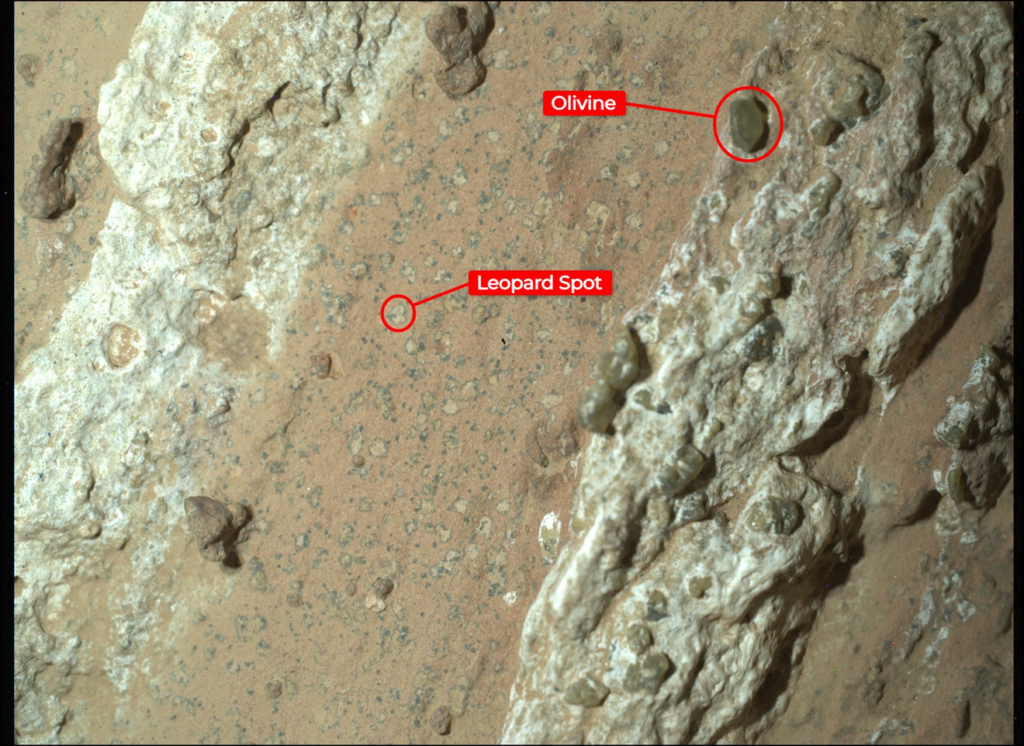
Calcium sulphate veins contain particles of olivine, possibly from higher (upstream) areas where magma came to the surface. Possibly this could indicate that the white veins were intruded at very high, unlivable temperatures. In that case, the leopard plains could possibly have formed without the intervention of living metabolism.
But more than these hypothetical possibilities cannot be extracted for now. Unfortunately, the instruments aboard the Perseverance rover cannot investigate more deeply. So it will be exciting looking forward to the sample return.
THE INSTRUMENTS SHERLOC AND PIXL
SHERLOC and PIXL are both mounted on the 2-metre-long robotic arm that also takes the samples.
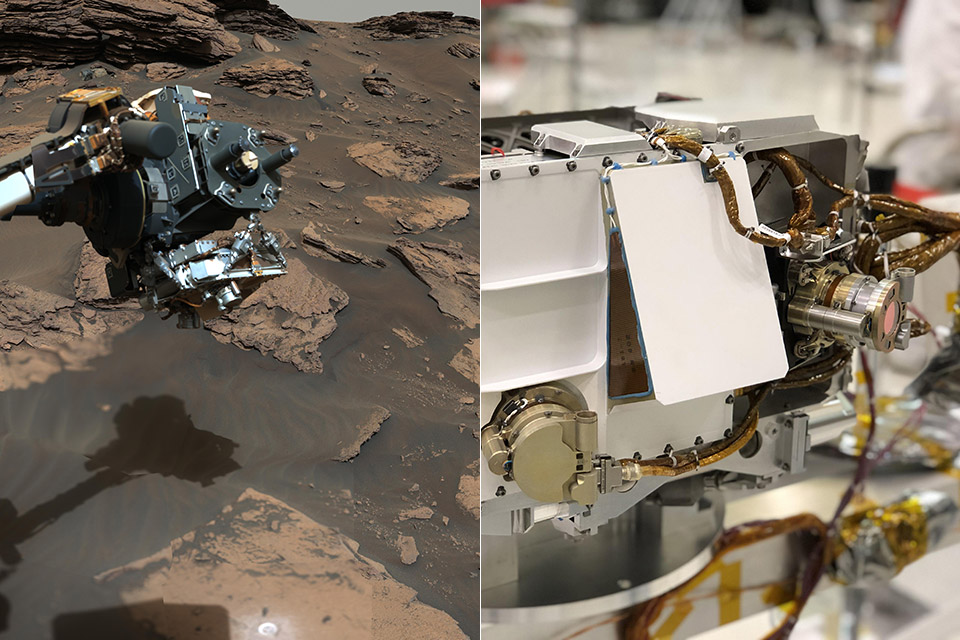
SHERLOC contains a black-and-white camera for capturing context and a colour camera (WATSON) that can provide zoomed-in detail images of stone texture and minerals. Furthermore, the instrument contains a laser to heat exact locations on the sample and spectrometer for its analysis. The instrument is designed to:
1) Determine in detail the presence of minerals containing CHNOPS elements.
2) Determine the exact location and type of organic molecules and their context in the surrounding texture.
3) Detect any biosignatures, based on the combination of observations.
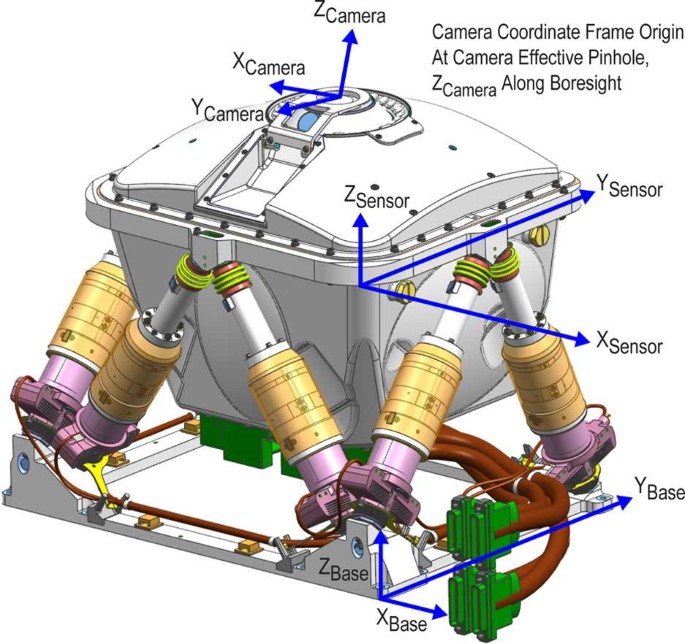
PIXL contains an X-ray fluorescence spectrometer. It allows you to determine the precise location and quantity of chemicals present in the rock. The resolution of this device is comparable to a grain of salt. The site of observation is first determined by a camera and a laser on PIXL. Then the X-ray is focused to the spot of interest to within 0.1 mm by means of six legs under the instrument that are controlled with AI. After 10 seconds of observation, the X-ray moves 0.1 mm. This creates a map of chemical composition about the size of a postage stamp.