
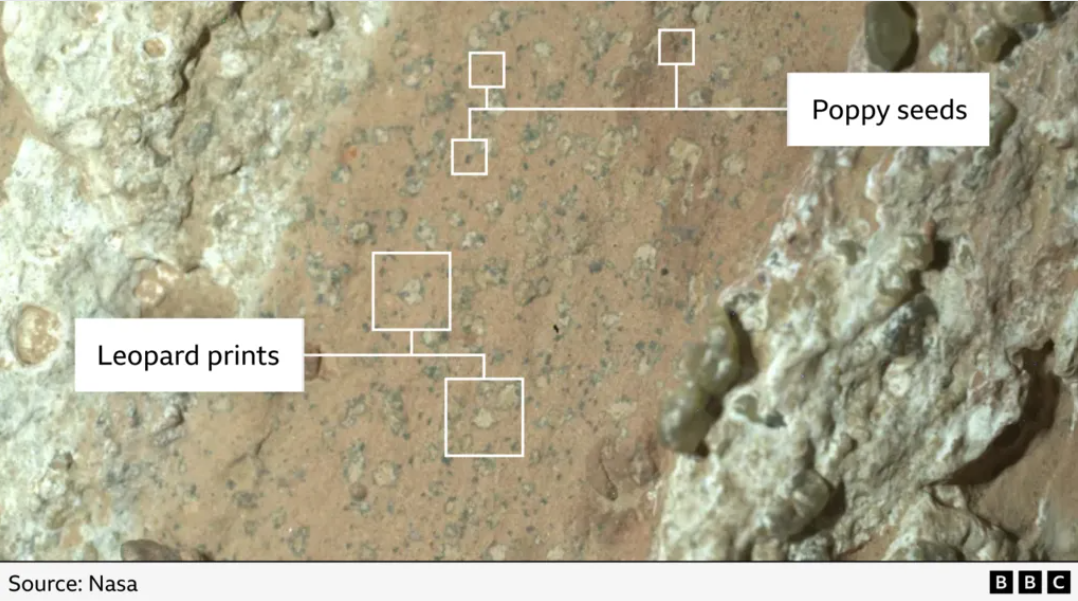
Image above: the spots this news is about: ‘leopard spots’ and ‘poppy seeds’. Source: NASA (Perseverance rover).
Source of news: https://www.nasa.gov/news-release/nasa-says-mars-rover-discovered-potential-biosignature-last-year/
Could it be true? Have we really found biosignatures outside Earth for the first time? Or is NASA trying to get extra media attention because of the heavy cuts they have to make? The news spread by NASA since yesterday is that the ‘Leopard spots’ and ‘Poppy seeds’, the specks found last year by Perseverance rover in Nevatna Vallis (inflow trench at Jezero crater), are now ‘almost certainly’ recognised as biosignatures of past life on Mars. So worth investigating a little further. And that is what I have done. Spoiler alert: I am already going to reveal my conclusion: Yes! it seems to me (and specialists in several interviews) that they have enough good reasons to be ‘almost certain’ that we have found a biosignature here.Why almost and not quite certain? Because you can never be sure that there aren’t chemical processes that we don’t know about, which could still provide an alternative (non-biological) explanation of the planes (but that’s unlikely). Actually, the scientists involved spent a year trying their hardest to prove that the specks could arise without the intervention of life. And they failed to do so!

What is it about here?
We have discussed this particular Mars sample before in this blog: Popular Mars sample from Perseverance. The dark spots called ‘poppy seeds’ are usually slightly smaller than a millimetre. The leopard spots are centrally pale (brown-yellow-white), with a darker border around them, and are sometimes larger than a millimetre. They were found in the so-called “bright angel formation”, a place with many diverse layers and structures, quite complex and with many traces of erosion. All rocks there contain fine grains, a mixture of clay and loamy rocks. Instruments with NIR spectroscopy indicate most of the rocks are slightly hydrated, and Raman spectroscopy indicates quite a lot of organic matter. These rocks are located in the inflow channel of the fossil lake of Jezero crater (i.e. next to the crater itself), and are estimated to be about 3.5 to 3.8 billion years old. It is also more than 3 billion years since liquid water was present at this site.
What is the chemical composition?
A fair amount is known about the chemical composition of the specks, having been studied by Perseverance instruments such as SHERLOC and PIXL. The colour of the specks comes mainly from two minerals, Vivianite and Geigrite:
Vivianite: hydrated iron phosphate: Fe3(PO4)2-8(H2O). This hydrated mineral is thus composed with reduced iron (Fe2+) and phosphates. On Earth, it is deposited in iron-rich and water-rich environments with a lot of organic carbon and a lot of phosphate. So mainly in places where dead, decaying organisms come into contact with iron. For example, inside fossil shells or on iron parts of coffins after burial. It can also occur without the presence of life, but as far as we know only deep underground, where the water present is under very high pressure and very high temperature (minimum 120°C). And of course, the surrounding rock must then also be rich in phosphates, organic molecules, and iron.
Greigite: iron sulphide: Fe2+Fe3+2S4. This is a combination of iron (reduced and oxidised) and sulphur. Note that it is not sulphate (oxidised sulphur), it goes or sulphide, i.e. the reduced form. On Earth, it occurs in river deposits containing mostly clay and loam. The environment must be oxygen-poor, otherwise the sulphur will oxidise and form sulphates. It is a deposit product of sulphur-reducing bacteria, but it is also formed without the intervention of life. For example, as precipitation where iron and sulphide are dissolved together in water (without oxygen) or in volcanic activity.
Can you have these minerals without life (abiotic) in that place? NO
NASA scientists spent a year investigating whether these two minerals could form without the intervention of life, and without high temperatures. Indeed, it is clear from the observations and the geological context of Nevatna Vallis that the Bright Angel formation has never been subterranean. It is clear that these rocks have never been under high pressure for all those billions of years, and that their environment always remained cold (already certainly no more than 100°C). Should you already have water at 120-200°C, the high pressure is still necessary to keep that hot water from boiling away immediately, preventing the vivianite from forming. Above ground, therefore, this is impossible.
Especially for vivianite , the decision is very clear: no matter how much one searched, it is impossible at this point to conceive of an abiotic way that vivianite could have formed in the Leopard spots or the Poppy seeds in the cold environment where they occur. It is also difficult to explain that the phosphates are concentrated in such high doses in the spots, without the intervention of biomass. Biomass has a much higher phosphate concentration than most abiotic environments. Should you already have that much phosphate concentrated for other reasons, it still doesn’t work. This is because the surrounding rock also contains a lot of calcium. Then calcium phosphate would form much more easily than iron sulphate. Something must have actively brought the phosphate and reduced iron together or made them react with each other instead of with calcium.
Abiotic formation of greigite is also unlikely at this site. The zone is sulphur-rich, but in reactions with iron, it would be much easier to form sulphates (oxidised sulphur) than sulphides (reduced sulphur). People have investigated whether it might be possible that the surrounding organic molecules could spontaneously react with the sulphates in such a way as to convert them into sulphides. It turns out that such reactions would be so incredibly slow that they could not possibly explain this deposition. You would already have to have extremely high temperatures to accelerate these reactions, and even then it remains unlikely. Those higher temperatures have certainly not been there. The intervention of bacteria-like life reducing sulphur, on the other hand, is an easy explanation.
So it is not at all crazy for NASA to make this decision. If someone can come up with a plausible explanation to explain the abiotic origin of the minerals, they are of course willing to revise their opinion. But right now, the decision is: the only explanation for this sighting is to consider it a biosignature! Traces of a form of life that deposited these nodules on the rocks (underwater) more than 3 billion years ago. What a news !!!
So why still remain so cautious in the message? Because you can never be sure if there is a chemistry at play here that we simply don’t know about yet. We remain scientists (or nerds?).
Now what?
Three regrets: we have already exhausted all possible means of studying the specks on the ground. In other words, the only thing left for us to do is to simulate ever better conditions on Mars here on Earth in the lab, and thus build up even more certainty about the decision that there are no abiotic ways for vivianite and greigite to form at this concentration and in this environment. Confirming the same decision even more strongly …
So it is already anxiously awaiting the Mars sample return. When the samples are brought to Earth, we will be able to examine this particular sample in depth. What are the organic molecules found here (undeterminable with the Perseverance instruments on site)? And what is their ratio of carbon-13 to carbon-12? And if, for example, amino acids are found in it: are they homochiral or not (some the ‘left’ mirror image, only the ‘right’ or a mixture of both)? And so on. The investigation on Earth of these Martian samples is now all the more important than ever before. The most optimistic scenario is for the samples to land on Earth by 2031. But the current US administration’s austerity drive affecting NASA and the uncertain economic times in Europe do not bode well. A Mars Sample Return will still require a lot of budget. But maybe the Chinese could pick up the samples one day?